
For the longest time I used only the Jane English and Gia Fu Feng translation of the Tao Te Ching, I never found myself wanting or needing the Tao’s words of wisdom rearranged or reinterpreted. Then, sometime last year, I picked up Steven Mitchell’s translation. It’s different. Contemporary, but authentic and in the spirit of Tao. It belongs as a perennial bloom in the garden of wisdom.
For today’s post, I opened the book and flipped randomly to verse 67. Here is a photo of the passage:
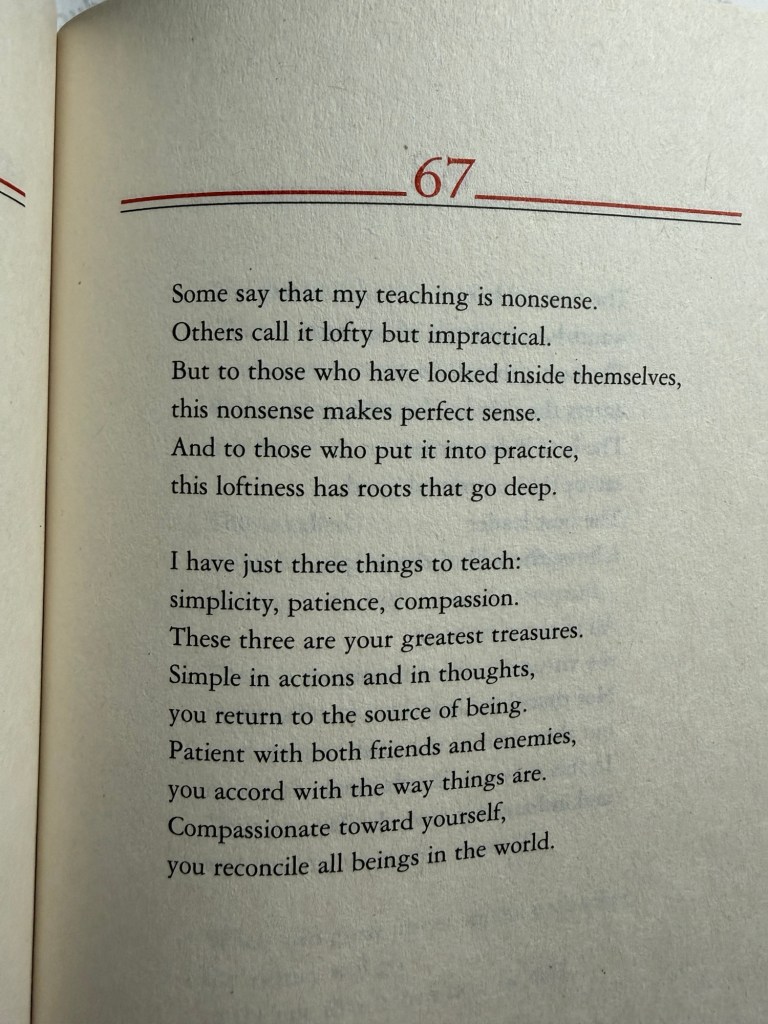
“Some say that my teaching is nonsense. Others call it lofty but impractical. But to those who have looked inside themselves, this nonsense makes perfect sense. And to those who put it into practice, this loftiness has roots that go deep.”
As Adam Robinson says, “the world always makes sense, it’s our models for understanding it that are flawed.”
When “nonsense makes perfect sense”, simply means you are aware that you should lean into what doesn’t make sense, what you don’t understand, rather than rejecting it or rewriting it in favor of your model for understanding the world.
How would that look in your nose work relationship with your dog? Anytime your dog does something you didn’t expect, make space for it. You might gain understanding in an instant (my dog doesn’t want to cross the start line, I can now see he’s staring at a squirrel traversing a fence in the far distance), or you might lose understanding to the point where you feel truly lost (my dog keeps taking me back to this bathroom and acting like there is a hide somewhere, but he doesn’t indicate it, at first I thought there was a hide, then I thought it was just pooling, now I don’t know what to think). With time, you will come to trust that nonsense always makes perfect sense, but you don’t always have the model to understand it.
If you can examine yourself and replace nonsense with “wholesense”, welcoming the clues from your dog, the environment and yourself, you can minimize your use of flawed models for understanding the search. Wholesense is really just a practice or a habit of deep listening and conversation when searching with your dog.
As the verse says, “And to those who put it into practice, this loftiness has roots that go deep.” It is not a lofty idea or an impractical task to listen to and connect with your dog and yourself. It is not easy, either. Nor is it always comfortable. But, it is the roots of your relationship. You might believe a competition partnership is healthy based on the titles and placements acquired, but unless the team has deep roots, there will be no enduring health in that relationship.
I have just three things to teach: simplicity, patience, compassion. These three are your greatest treasures.
Nothing to add here.
Simple in action and in thoughts, you return to the source of being.
The source of being is Tao, or The Way. It is the path to harmony and flow. Less thinking, less doing, more being. Being is presence, awareness, connection, co-creation, struggle, growth, rest, realization.
In nose work, simplicity is you and your dog in the search for the possibility of odor. No need for start lines, no need for skill levels, elements, pooling, channeling, inaccessible, time limit, boundaries… Simplicity is your mind attuning to what is happening, to what your dog is communicating. Simplicity is your actions flowing from the energy of what wants to happen now, not what is the one right thing to do now, just, what wants to happen now. It is the action of stillness when you sense you’re losing your way.
Simplicity isn’t easy. It requires intention. It’s often counterintuitive. Just when your mind and body want to take hold of an experience, simplicity asks you to loosen your grip, or to let go as the way forward.
At this summer’s scent work camps, one of my search locations was the instructor’s ranch house. Not having a pre-planned idea for what we would experience, I formed the search moments before the first group arrived. I kept it simple in action and in thoughts. I’d been unable to finish my breakfast burrito in the short window of time between my morning run and the start of the session. I took a small tube hide and tucked it under the lip of the plate holding my half eaten burrito. I left the plate at the edge of the kitchen island nearest the refrigerator. I exited the ranch house and let the group know we would start running dogs and see what they tell us.
Dogs generally keep it simple when searching. They communicate the situation as it appears from their perspective. We complicate the search by clinging to what we think is happening and rejecting what is actually happening. In the “Burrodor” or “Odorito” search, dogs told us where odor was collecting and where it was coming from (the plate). People saw a burrito on a plate, and various levels of murkiness resulted in back & forth conversation between dog and human. When a human rejects the possibility of odor under the plate, the dog can try to force reality on the human, or he can co-create a fantasy of source located somewhere more likely – a stool, a cabinet door, the fridge, or somewhere far away, like one of the bedrooms. Or, the dog can just decide to stop participating until the human comes to his senses.

Simple in actions and thoughts. If you had to focus on simplifying just one of those two, I’d focus on thoughts. Notice what is in your mind when you search. If you’re already answering, “nothing, I’m focused on following my dog and watching my dog.” That would be cool, but it’s probably not true. Unless you are Matthieu Ricard (world’s best meditator) your mind is probably full of thoughts while you search. Step one is notice the thoughts, step two is replace those thoughts with observations of your dog (his pace, his tail, his breathing, his energy). That’s it. If you consistently practice doing this, your mind will actually focus on your dog, and your actions will likely be better aligned with what your dog is trying to accomplish.
Patient with both friends and enemies, you accord with the way things are.
“Friends and enemies” can be interpreted as “things I like and things I don’t like”. In nose work, the search area is something humans like, the area outside of the search is something humans don’t like. We humans tend to put our likes and dislikes into an automated program in our brain that just reacts to stimuli without hesitation. In the case of search boundaries, we are more likely to let a dog fart around with non-target odor for a long time within a search area, and less likely to let a dog have even a second to pursue target odor beyond the search boundaries. We are not actually engaging the dog based on his searching communication, we are reacting to our “friends and enemies” in the context of the search.
If you have patience with both the dog’s behavior within the search, and the dog’s behavior at or beyond the boundaries you are able to “accord” or agree with the way things are. This is worlds away from mindlessly reacting (dog in search area, I like it regardless of the communication I’m getting; dog leaving or outside of search area, BAD! I don’t like it!). Patience equals presence, awareness, acceptance – regardless of the dog’s location, within the search area, or at/outside the boundary, you are patient and able to agree with the way things are. When you are able to agree with the way things are, you improve your ability to communicate with your dog.
If you find that patience does not lead to agreement with the way things are, you should stop your search and make sure your mind is free of friends and enemies type thoughts, make sure your dog is feeling confident and happy, and then resume your search. Patience and a clear mind should make right thought and action simple.
Compassionate toward yourself, you reconcile all beings in the world.
Nose work people love to be hard on themselves. “I’m the dummy at the end of the leash.” “It’s my fault we haven’t titled yet.” “Stupid human.” These thoughts do no good, rather, they can be quite harmful. The harm isn’t just self-inflicted, you harm your dog when you are self-critical. When you engage in negative self-talk, you chain yourself to a fixed mindset and severely limit your team’s growth potential. Blame and shame are easy. Compassion is hard, but it’s the better choice.
Compassion can seem like being permissive of poor performance, of failure – letting bad things happen (patience with your enemies, remember?!). Compassion isn’t what got you into a bummer of a situation, but it can be what gets you out. Compassion means “to suffer with”. Think about suffering with yourself as you go through an experience, rather than judging yourself. John Tarrant, Zen Buddhist, says, “suffering is the phrase “not this”, while enlightenment is the phrase “what is this?”” Compassion helps you stay with “this” so you can move towards “what is this?” with wonder and peace.
Compassion is hard, but it is the way forward. Let’s say you are in a workshop group and you call a false alert in front of the group. The typical reaction is to move away mentally and physically from the source of suffering (not this). The compassionate reaction would be to sit in that failure for a few moments and open yourself to possibility (what is this). Often, you and the dog were connecting on something important that led to an indication and an alert call, so staying with that connection despite the suffering of a “no” can quickly lead to a correct indication. Sometimes, the false indication (communication initiated by the dog) or the false call (declaration chosen by the human) can come because dog and human are unable to agree on the search being over (no more hides to find). Compassion keeps us in the experience of doubt and uncertainty, it keeps us in the space where reconciliation happens. Where learning happens.

Verse 67 does not say compassion towards others, also known as pity. It is very easy to pity others. But, that is not going to help us grow. Compassion towards yourself leads you to “reconcile all beings in the world”. Reconcile, in this context is to bring together. So, when you do the hard work of suffering with yourself, you achieve the desired goal of connecting or reconnecting with other beings. This is the core of relationship. You and your dog like to be together, you like to search together, you’re generally connected. The unpredictability of searching (of life), will pull you and your dog apart at times, compassion for yourself will lead you back to each other.
Verse 67, The Troubleshooting Guide For Stuckness In Nose Work
Do nose work for any length of time and you will end up stuck. It is part of the game. It is the most important part of the game. Time limits, search area boundaries, and coaches can keep you from getting stuck or rescue you from being stuck. Get stuck as often as you can tolerate. It is where the learning hides. When you find the learning in a particular experience of stuckness, consider what it means for your dog, for you, and for the two of you as a team. Remember to use your three treasures: simplicity, patience, compassion. Your dog will have fun when you are having fun, so don’t forget to have fun being stuck.
If you enjoy the blog, please consider donating. It’s highly likely that donations are the fertilizer of blog posts. I have many blog post seedlings waiting to be fertilized!
Happy Sniffing!


Leave a Reply