
“In my life I’ve discovered that if I cling to the notion that something’s not possible, I’m arguing in favor of limitation. And if I argue for my limitations, I get to keep them.” – Gay Hendricks, author of “The Big Leap”
“Stand in the same place and become trapped in your reality. Move around and your choices become infinite.” – Jeff McMahon
Years ago, I made my big leap away from group nose work classes. I was excellent at the group class model, coaching 100 students a week, coaching many students to high performance and top placements in competition. But, I wasn’t living in my “zone of genius”. I knew I had to get out of my comfort zone and follow my passion. I needed to coach individual teams in dynamic settings where I could inspire them to leap towards their zone of genius. 5 years into this big leap I have shared so many magic moments with dogs and people in our 1 on 1 sessions, it has been incredibly fulfilling. And, I know there’s still more to do. What will my next leap look like? I don’t know, and I don’t need to know, I only need to focus on a daily practice that welcomes the signs of obstacles and limits and frees me to expand in my zone of genius, then my path and the next big leap will be one and the same. Gay Hendricks and his books, specifically, The Big Leap, have inspired me and given words and guidance to things I’ve always felt on some level. Hopefully, he’ll inspire you, too. 18 years into the game of nose work and I’ve never seen a dog hold a person back, but I’ve seen numerous instances of dogs waiting for their people to make a big leap. Now is the time. For you. For your dog. Let’s Go!
What Is This Place?
“Graeser Park Historic Wayside Rest” says the heading of the google maps description. I toggle between the satellite view and the description as I try to figure out what this place is. A triangular green space sandwiched between a freeway and a major road. An old rest stop. Weird. An old rest stop turned park in a first ring suburb of Minneapolis. I feel the pull. My inner voice says, “this has got to be a fun place to do nose work”. Other voices in my head, say “what if it’s lame? What if it’s not big enough? What if there are no good search areas? There are so many other good places you already know about.” I let my quiet inner voice guide me, “don’t think, just go.” I pick up my phone and message the park location to my students.
The next morning I make a point to get to the park before my first student arrives. The navigation on my phone tells me to exit the freeway, then turn right, then a sharp left. It feels like I’m being u-turned back onto the freeway. I scan my surroundings, All I see are major roads and a neighborhood. I begin to think I’ve been duped by google, like when you look up a cool restaurant and you drive 40 minutes to find that it’s been closed for months. I follow the suggested route sandwiching me between the freeway and a neighborhood just new enough not to be considered a “charming older neighborhood”. After a third of a mile that feels like 10 miles, I emerge to behold a surprise green space ahead of me, and just a half block further, another major road. And just beyond and above the park, the freeway on/off ramps. By nearly any perspective, this place doesn’t exist!
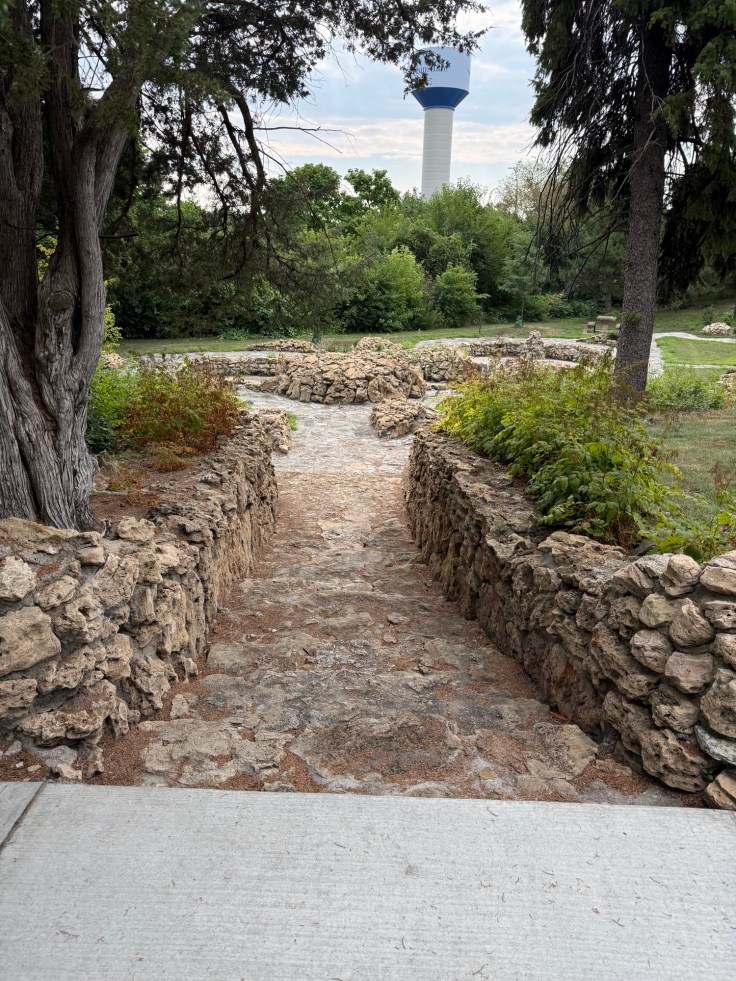
I park the truck and look before me. Trees, grass, some interesting stone walls and picnic tables. Not bad, but not worthy of my inner voice pulling me to this place. I walk into the park. among the stone tables is a “beehive” oven, the google description informed me it is one of two remaining in the US. Cool. I almost don’t want to put hides on it, but it looks restored, so maybe just one hide… I circle the oven and look at what’s left of the park: not much. There is a portable water tank next to what look like stone walls for a set of stairs, and to the left of all this is a small pond, guarded by heavily overgrown brush and extra weepy weeping willows. I head towards the stairs.
“What am I looking at?” I say out loud to myself as I stand at the top of a short stone staircase staring hard at the image before me as if it were a stereogram that reveals itself with the right viewing technique. I feel a childlike energy to explore. I bound down the stairs, quickly discovering the natural chaos of the stone surfaces beneath my feet, and the presence of mind and body required to move at any speed beyond a tip toe. Limestone walls with oversized built-in Kasota stone benches ring the sunken area. Piles of Holey stone appear along the pathways as if dumped from the sand buckets of giant toddlers. At the center of the area is a two-tiered Holey stone and concrete pond with what looks like a fountain in the form of a mini mountain of rock. The pond is dry, the concrete marked with wisps of green where weeds have filled and expanded the cracks. I jump into the basin of the upper pond, looking around from the center. If fairies had darted in and out of the holes and crevices in the stone, it would have made perfect sense. What a cool place!
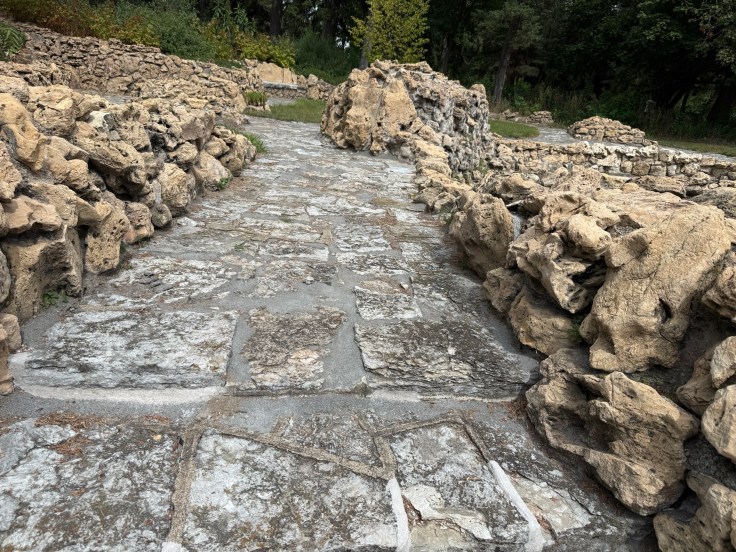
As I begin placing hides in the rock garden and throughout the rest of the park, I’m eager to see what my students and their dogs will think of this place. Session after session, dog and human are as surprised and delighted by this hidden historical oddity as I am. After her session, one student messages me regarding time spent with her dog, “It was an exceptionally good day for him and me.” Her previous session was at a baseball field complex with kids everywhere – some on electric scooters – and baseballs being pitched and hit, and her dog was amazing. He didn’t spend a moment paying attention to any of it. But, it felt more like work. At the fairy garden, we were, to quote Gay Hendricks, “seeking in the spirit of play.” All of us were immersed in the strange wonder of this rest stop, our attention fully presenced in mind and body – odor seeming to dance through the space, as if carried along by the flutter of fairy’s wings. We were beyond odor theory. We made the leap to odor magic.
This is my zone of genius. I feel a place, I create a feel for the dog and the person, and we share an experience with the possibility for magic. When I’m living in my zone of genius, I inspire others to do the same. It’s a gift to me that I share with others. I’m grateful and thrilled when it happens.
A Place To “Savor Natural Good Feelings”
As much as I want to enjoy the novelty of the wayside rest stop every day for the rest of the week, I soon feel pulled in a different direction. I look at the dogs on my schedule for the next day and see if a location from a past session comes to mind. Within seconds I have my plan for the next day. One of the dogs on my schedule loves rules, but truly grows when we ask him to search outside the rules, to be fluid and adaptable. We’re going to do our searching at a location he’s been to numerous times over the years, a location where the rules feel well established. A location where I’m going to ask him to toss the rules out of the search area and make a big leap.
Like the fairy garden wayside rest stop, the location for this day butts right up to the freeway, but that’s all these two locations share in common. There are five structures we have available to search: three huge industrial buildings, a large office complex, and a health clinic. I park in the health clinic lot next to the only other vehicle, a black SUV shaking from the force of the barking fur missile in its cargo area. I meet my student at the rear of her vehicle as she lifts the hatch, putting me face to face with hot breath, sharp teeth and the impatience of expectation. This dog is used to starting his hour of searching with two challenging large area searches of high hide count or unknown number, and finishing with a few simple, small, single hide searches. He brings high energy and intensity to these sessions, but I wonder if he’s just counting on things to get easier as the hour unwinds. For his prior session, we started with simple, small, 1, 2 or 3 hide searches that he just crushed. Then, for his final two searches, we gave him expansive, high hide count, complex puzzles – stuff he’d typically carve up at the start of a session. On the last find of his last search, he looked like I do at mile 75 of a 100 mile race, dragging himself around the search area, searching as much for his lost problem-solving skills as he was for that last hide. He managed to make the find, but we could see that his world had been rocked.
After the unexpected challenge of difficult searches late in the session, I wasn’t sure what this dog would think if we kept the script flipped for a second session in a row. His rules were broken, his expectations upended. Would he stand at the start of his final two searches with the same energy of openness and play I felt at the top of the stairs at Graeser Park, or would he be drained of energy by his own limitations, his reliance on the rules?
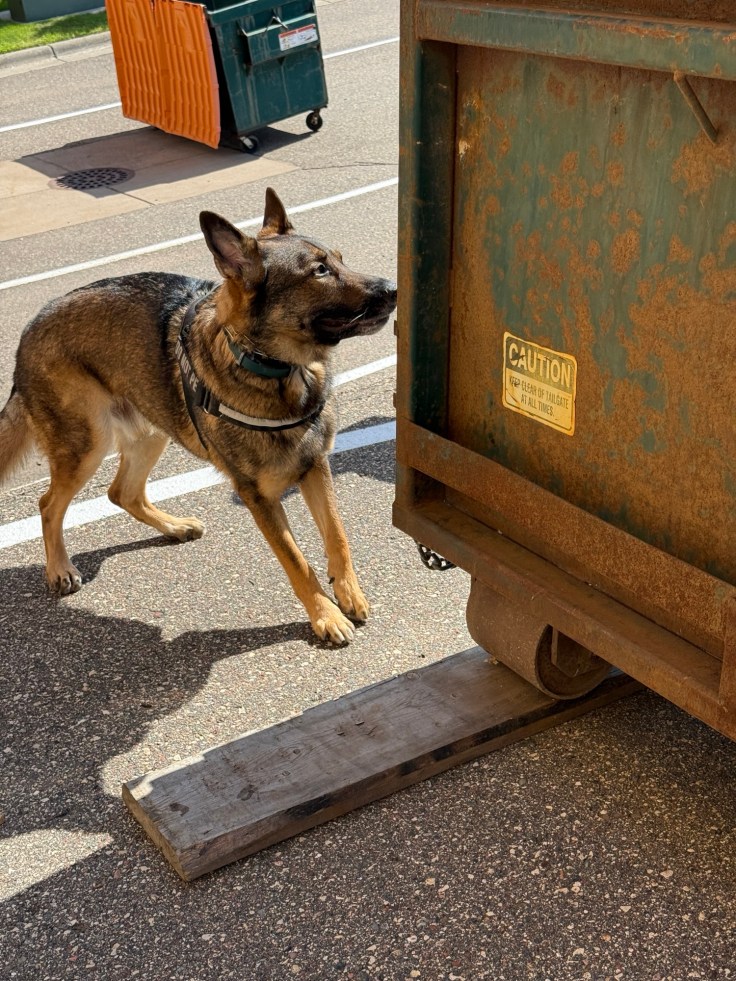
The session begins with a couple of single hide searches, and a compact, 3 hide search. Then, I set the first of two big, complex searches, 7 hides: 4 close together, 2 ground hides, and 1 hide suspended 5ft up in the low branches of a tree, the wind blowing it a hundred feet to one of the ground hides. He eats up 5 of the 7 hides in short order. The suspended hide challenges him, but he eventually settles his focus calmly on the source, standing and staring at its exact position. The final hide, one of the two ground hides, comes together slowly after the long battle with the suspended hide. On any other day, this would be a search victory to end on. But, today there’s one more monster search on the menu.
For the final search, we cover a massive area including three sides of a large office building, the building parking lot and the adjacent grassy areas. I place 3 hides, each one given to the environment in hopes of creating something challenging and fulfilling for this dog. Starting at the northwest corner of the building, he takes off down a sidewalk above and alongside the ramp to the building’s underground parking garage. The wind gusts at his back as he runs towards the building corner and hits the brakes, hopping and spinning around, racing to the top of the ramp where a concrete wall with a metal guardrail begins, finding the first hide under a hunk of broken concrete. The way he works this hide, he seems determined, but tired. After a pay and a victory bark, he hugs the building and works systematically along walls, into corners, up and down accessibility ramps, around trees. A small bunny flushes from some shrubs 10 feet ahead of him, but the dog has such laser focus he doesn’t even flinch. As he reaches a large concrete entrance area at the building’s main doors, he turns away from the building towards the large parking lot and takes a few strides into the wind, then he turns back and moves to a circular planter with a flag pole in the center. Here he whips around to the parking lot and charges into the wind. For the next 30 seconds he rides waves of odor on the asphalt ocean. He cuts back and forth into and with the wind. He and the hide make an agreement to find each other. An audience of geese at the edge of the parking lot has seen enough to know this dog can hunt. They honk in deference to the formidable predator and hurl themselves into the sky. The wave of odor crests, the dog settles at source. This stretch of the search, while full of movement and action, seems calming and energizing. Sure enough, the dog is ready to seek out that final hide.
With the wind at his back, he goes in search of any tendril of odor that could lead him in the direction of source. He leaves the parking lot to briefly check the building, then he cuts back into the parking lot as he moves confidently and with a new sense of his endurance, like he’s just stepped beyond his limit to find it nothing more than a mirage. After a few hundred feet of zigging and zagging through the parking lot, he picks up on what he’s looking for. I’ve placed another suspended hide in the branches of a tree, this one right near an aluminum address sign in a river rock landscaped island just inside the southeast entrance to the parking lot. Within 10 seconds, the dog closes in on the tree and the sign, climbs the sign and sources the hide in the nearby tree branches. When I toss him his tug toy, he snatches it from the air and races over to tease me with it. We tug for 30 seconds as he bounces up and down with joy, savoring the natural good feelings of hard work and newfound ability.
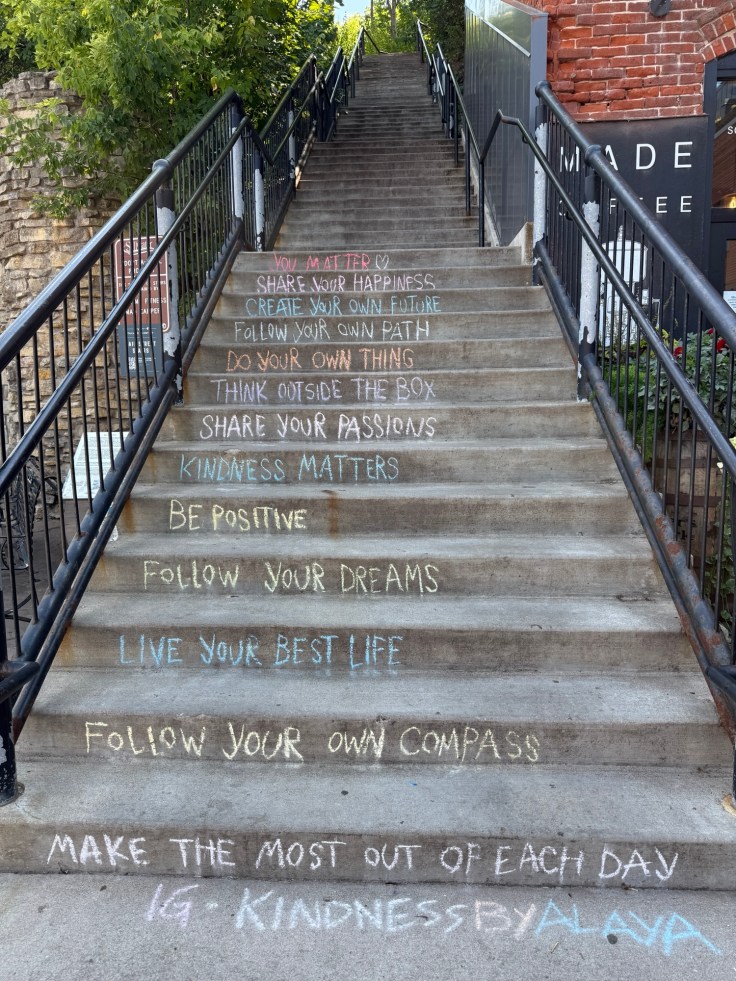
I know what it is to savor natural good feelings, too. Later that same day, I spend 90 minutes running up and down 157 steep outdoor stairs 32 times. During that hour and a half, my mind decides I’m done several times. Each time my mind is wrong. Not just a little wrong, completely wrong. Even when my body seems done, I can still do more. It feels so good to push my limits. That morning, watching the dog savoring natural good feelings after working hard and pushing through his limits, I knew we’d made a fundamental shift in his perception of the possible.
Feather Or Sledgehammer?
“The universe will teach us our lessons with the tickle of a feather or the whomp of a sledgehammer, depending on how open we are to learning the particular lesson. It took me a long time to figure out who was in charge of the painfulness of my lessons.” – The Big Leap; page 194-195
At this point in my nose work journey I rarely get the sledgehammer when the universe is teaching me a lesson. This is simply because I’m very open to whatever a dog wants to reveal to me, and I’m looking to be surprised. When I do get a whomp, it’s usually because I’m a bit less open with people. The lesson I get whomped with is usually in relation to a person’s needs for security, approval, control and oneness, and how those needs being met are integral to the dog’s needs being met. This past week, I got whomped by the universe.
I spent half of a session in open bliss letting a dog communicate and waiting for her human to receive the communication and take action. The human spent that same half of the session sending me distress signals, getting frustrated, and struggling to connect with her dog through the game of nose work. Whomp whomp, Jeff! Okay, this sledgehammer was more of a sledgetickle. The second half of the session, we invited the dog to play the game in a very simple way to help the human get her needs met. It was a lovely series of searches, and the human was able to relax, enjoy, and connect with her dog. We finished with a more typical search that unfolded in a way both dog and human found fulfilling.
Lucky for most of us, one whomp from the sledgehammer of the cosmos doesn’t knock us out, it just forces us to redirect our focus or face another, more painful whomp. If we turn our awareness toward why the universe used its sledgehammer on us, we are more likely to receive tickles from the universe in the future.
If we could all agree to get together for lessons from the universe’s feather when we get together to do nose work, people and dogs would learn a lot more – and probably laugh a lot more, too.
🎶Get In The Zone, Genius Zone!🎶
“It’s worthwhile to do something you’re not good at if the intention is to enjoy or master it.” – The Big Leap; page 30-31
Gay identifies four zones you can be in in life, work, love, etc.: incompetence, competence, excellence, and genius. The goal is to live in your zone of genius most of the time, to flourish in your zone of genius, and to inspire others to do the same.
The other three zones are suboptimal, however, Gay lays out a case for why you’d spend time in a zone other than genius: if you enjoy something or if you intend to master something.
Do you intend to master the game of nose work? If yes, you should expect to progress towards mastery as you invest time and effort in the game. if you have a dog that fits your goal, it will make progress easier and faster, if you don’t, you may have to do a great deal of behavioral manipulation to get the performance you want out of your dog. If you are doing nose work for pure enjoyment, you need not worry if you’re mediocre at it. End of story. I am sometimes in last place in a trail race – I’m not trying to master the game and be the best, I’m just enjoying myself. I love to do puzzles, and I’m not concerned with techniques that might help me complete the puzzle faster – in fact, I quite enjoy taking my time.
Just have fun and enjoy the game of nose work with your dog. Sounds easy, right?! It is easy, if you intentionally craft a practice of enjoyment. If you just show up to class, to a trial, to wherever without clear intention, you will be shaped by the predominant forces of your environment. And, guess what? The predominant forces of the class and trial environment funnel people and dogs towards mastery, regardless of if it brings them joy. This is not inherently bad, but the reality is that most people aren’t looking to master most things, they’re looking to enjoy themselves. Be intentional about enjoying your incompetence.
If you truly believe mastery of nose work is for you and your dog, awesome, dedicate your time and energy to climbing that mountain. No one should be discouraged from trying to be a nose work master – especially if dog and human are enjoying the struggle towards mastery. If, at some point, you question if mount mastery is for you and your dog, pitch a tent on the cliff face and get perspective. Maybe you need to renew your commitment to getting to the summit. Maybe you need to listen to a fundamental shift in what you value, and descend back to the hills and valleys of incompetent enjoyment.
Just in case you think your only options are to be a happy idiot or a stone cold stud, that’s not the case. You can be whatever you want. You can be in your zone of competence or excellence in nose work. Your dog can be a genius and you can be incompetent. The key is to be intentional about why and how you make time for the experience of nose work with your dog.
Time Cops, Time Slackers And Einstein Time
“I’ll be blunt here, just as blunt as when I’m confronting limitations in my own mind: Quit thinking time is “out there.” Take ownership of time – acknowledge that you are where it comes from – and it will stop owning you. Claim time as yours and it will release its claim on you.” – The Big Leap; page 176
I’m a time slacker. I find it silly to structure our lives around these arbitrary units of measurement of something that is ultimately relative. I get that we have to use time, but I also see the complete absurdity of the time hierarchy: a worker can be fired for being a minute late, a boss can show up whenever they want; I have to pick an appointment time for the doctor, but they get to choose when to call me out of the waiting room; I need to be to the gate to board my flight or they’ll sell my ticket, but the plane can sit on the runway for two hours and I don’t get anything but a cup of water and some biscotti. I’m fine living in a world where we act like time matters, but I do not take it seriously, nor do I force others to take it seriously.
I am not a time cop. See above. The time cops I know have a pleasure/pain relationship to time. It’s quite pleasurable for them or others (in relation to them) to be ahead of schedule or on time, and quite painful for them or others to be late or to disregard time. Time cops give the ultimate power to the clock.
Gay would call both the time slacker and the time cop, “personas”, and he would strongly suggest shedding either persona in favor of an ownership based approach to time. Both personas are convenient ways to avoid taking ownership over our ability to make time. The time slacker acts as if all activities are equally important to do right now, regardless of time commitments or schedule, and the time cop acts is if the time commitment or schedule is the most important thing to do right now, regardless of the activity. Both personas help us avoid taking ownership of our time and what we want to do with it.
Einstein time, as Gay conceives it, is simply an understanding of the relative nature of time, and of our ability to create time through our intentional ownership or disavowal of activities. We can make time, so we will always have time to do what we want. When we make the time to do what we want, we will be more present, flowing out from our center into our environment. All of us have glimpsed this way of being, when you get lost in an activity or a conversation and you feel like minutes have passed, but it’s really been an hour. This might frighten some people – if you spend an hour on an activity, but it feels like only a few minutes, are you not losing time? If you feel this way, you’ve probably spent an hour scrolling social media or something similar. An hour spent on something deeply meaningful and joyful will not be regretted. That is your guide.
When I get together to do nosePLAY with a friend, we might spend 3 or 4 hours playing, but I’m not aware of the clock. It feels like we are playing outside of time. That is my experience with Einstein time. When I judge people at trials, I can see that some people are trapped inside time jail. The experience of searching is guided by their awareness of the clock. I also see that some people can’t wait for the search to be over. It’s only a few minutes time, but it stretches on forever for them, and the relief is in the ending of the activity. Some of these people reward the end of the search with more emotion and enthusiasm than the search and the finds.
We humans have a lot of progress to make with respect to ownership of time-making, so much so, that we hardly “have the time” to consider a dog’s experience with time. I am sure some dogs are more like time cops and some are more like time slackers, in their own canine way. Certainly, some dogs have their own way of relating to time. Can we make time for a dog’s way of time-making? I’d love to see that more.
ULPs, Leaps, And Wood Decomposing Saprobes
“If you focus for a moment, you can always find some place in you that feels good right now. Your task is to give the expanding positive feeling your full attention. When you do, you will find that it expands with your attention. Let yourself enjoy it as long as you possibly can.” – The Big Leap; page 22
I closed my week of coaching with a visit to my two favorite parks from recent past: Graeser Park with its hidden fairy garden, and River Park with its cool deadfall tree play area looking out at the Mississippi River.
At Graeser, one dog needed a bit of feedback and guidance to put his full attention to the game of nose work. He’s been a rockstar in recent sessions, but this was such a novel area, he couldn’t decide what to make of it, and his response was to expand out and think about peeing. After a bit of guidance in his first search, he made a big leap – literally. He combined his excitement over the novelty of the area with his focus to do the work and he gifted us with a creative and exciting search, bounding through the area, leaping above the stone wall and benches, and climbing on top of the piles of Holey stone as he found the hides with confidence and joy.
At River Park one human needed a bit of feedback and guidance when she ended an unknown number search in a large picnic shelter after finding 4 hides – there were 10. She admitted that her expectations from past searches led her to decide to be done, rather than any particular communication passing between her and her dog during the search. We had a laugh about how easy it is for us humans to forget our human foibles, then we went to a smaller shelter and played a little game – we let her and her dog stand in the middle of the shelter and watch me place 10 hides. After the search, we both agreed her dog didn’t try to “mark” or remember the hide placements, he just used his nose and sniffed them out as if he’d seen nothing. We enjoyed this reminder to trust the dog and stay present in the search. Dogs are great at showing us how to move right past a potential limitation and expand in joy and success.
Gay created a term to describe what keeps us from our genius zone, he calls it the Upper Limit Problem (ULP). Basically, if things are going really well – if we experience a surge in joy, an increase in wealth, a career achievement or a creative success – we tend to self-sabotage in various ways to bring our “inner thermostat setting” back to its “old, familiar zone where we feel secure.” The specifics of how our thermostat setting got to be where it is are not necessary to get into in order to benefit from this concept, all that we need is awareness of the swing from more joy experiences – in love, success, creativity – back to our typical set point.
Dogs definitely face limitations – some appear as physical barriers, others seem more like mental limitations, but the most challenging limitations they face are not even their own, they are our limitations. If we are not present and ready to make a big leap, there’s a good chance our dogs won’t be able to leap either. For many years now I have used the mantra, “I’m grateful for whatever this dog wants to show me” before I begin to search with a dog – as a coach, a partner, or a judge. Now, I’m adding another mantra, “I expand in abundance, love, and success everyday, as I inspire those around me to do the same.” These mantras are simple ways for me to train my brain to be open, to be present, to use my skills and knowledge creatively, and to take big leaps. When we leave our ULPs behind, we free ourselves and our dogs.
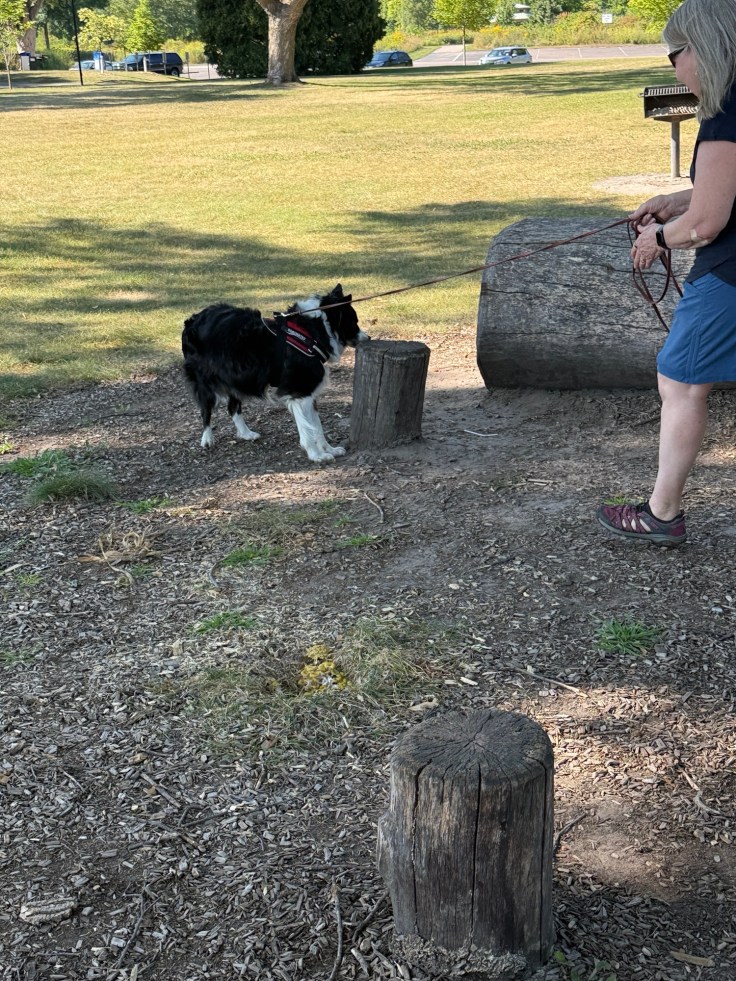
After the fun 10 hide search at River Park, I took the human and her dog to the deadfall tree play area for the last search of the session. I had placed some hides in this area maybe a week earlier, and I thought this dog would really find some of my chosen hiding places to be super fun – in particular, a hide I’d placed in a decomposing stump hole no bigger than a gallon bucket. The wood in the hole was soft and mixed in with wood chips used to keep the play area a bit safer in case of a fall. It made for a perfect “buried hide”. As I walked over to the spot, I noticed something different – food or trash, maybe? I stood over the hole and marveled at what looked like a healthy explosion of fungi! Golden oyster mushrooms it seemed. I left that hiding spot to the mushrooms and picked a nearby stump now functioning as a seat or a step, depending on your style of play and enjoyment. I placed a hide in a crack on the side of the stump, and placed two more hides around the area. The dog loved the search!
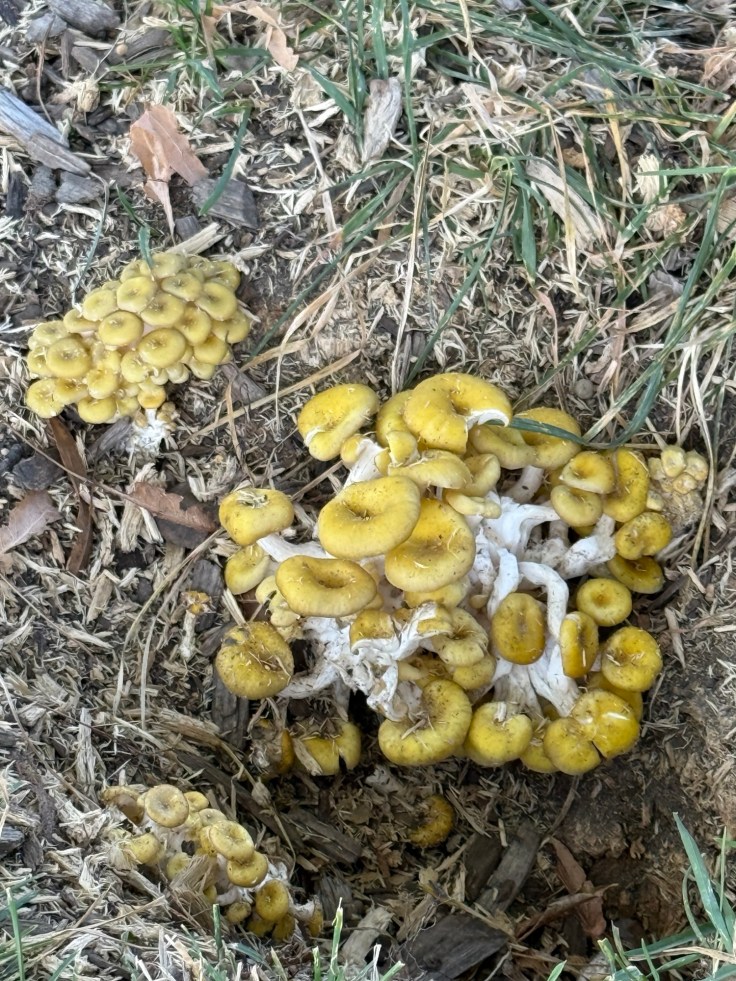
As I watched him find the stump hide, I thought about the sudden expansion of those mushrooms into the space I’d expected to have a long-term lease on for my future hide placements (abundance & success on display… and a bit of invasiveness, but it’s all a matter of perspective)! It was easy enough for me to expand and find another place to put my hide. It fit my new mantra, “I expand…” That’s the important part. Expand. Open your mind, open your heart, seek in the spirit of play. This past couple weeks has truly been full of inspiration and joy, and there’s no upper limit, but the one I set for myself.
Happy Sniffing!
P.S. – if you enjoy this blog, please consider making a donation or using this affiliate link to purchase the Big Leap. It’s much appreciated!
 Sniff This Blog
Leave a comment