
Yes. No. Maybe. It depends. Got all our bases covered? Good.
What is the Hawthorne Effect? The name comes from studies conducted at the Hawthorne Works factory, studies that discovered worker productivity increased simply because workers knew they were being observed, not because they were working in better or worse conditions. This “observer effect” has been found to alter people’s diet and hygiene habits, making some studies suspect – or simply highlighting that if you want someone to eat the sweet potato and not the stick of sweet cream butter, just give them a literal human weight watcher.
Ok, your dog might try harder when you’re watching, but try at what, and try how? You could experiment: hang out with your dog in a room and don’t pay any attention to him. Then, start paying attention to him in a very obvious manner. Too busy to experiment? I did it for you. As I was writing the preceding sentences, my dog Miles was asleep in his bed a few feet from my desk. I snuck a look at him. He was eyes closed snoozing. I went on typing, then, I stopped typing and sat back in my chair, turning my shoulders towards his bed and fixing my gaze on him. He powered up in stages. First, his eyelids gently fluttered, then his eyes opened and began to look softly back at me. Next, his eyes started darting back and forth, along with his ears. This dance went on for 10-15 seconds. His eyes sharpened and stared into mine. Within another few seconds he popped up from his bed and sped over to me. Experiment over. I scritched his chin and went back to typing. Within a few seconds he returned to his bed and went back to sleep.
Let the scientific record show that Miles, when observed sleeping, did not try to sleep harder. I love sciencing.
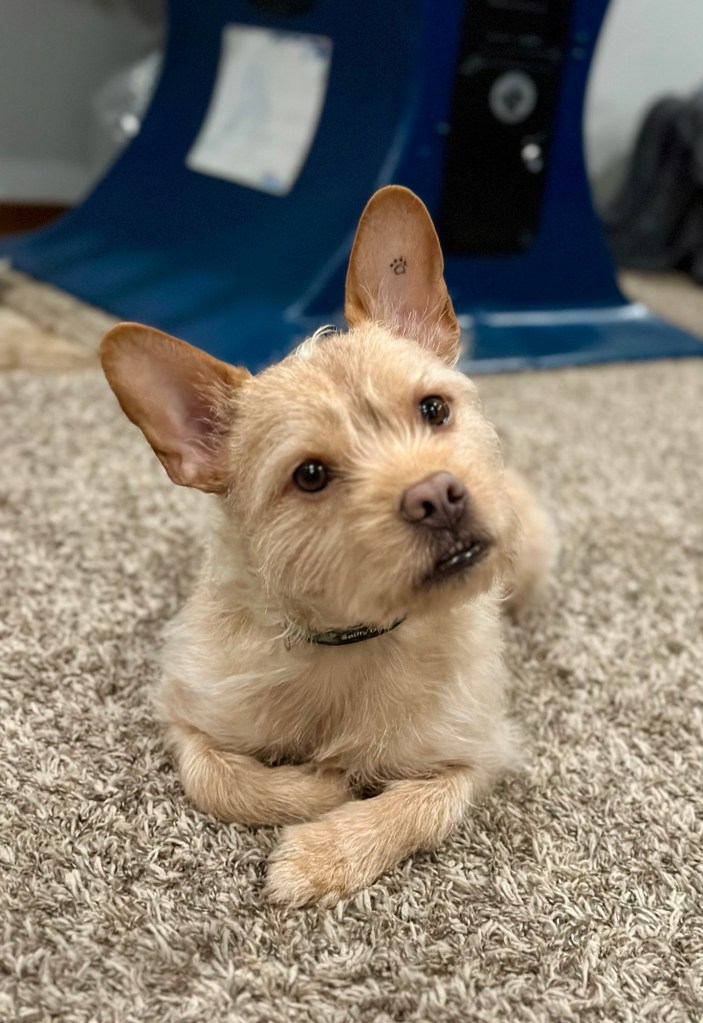
Ok, so my dog would rather awaken from slumber and get attention from me, than go deeper into sleep and get attention from me in a dream. That seems N-of-1 obvious. What can we think of that our dogs actually – upon awareness that we are watching – do harder? That’s a trickier question to answer. Sometimes my dogs seem to play harder – longer, louder – when they have an audience. My dog Miles hunts critters with or without me, I’m pretty sure he tries just as hard with or without me watching. My dog Muriel wouldn’t do anything without me, and I mean she would just sit in place and wait, as she did one day for probably 8 hours when she got locked out of the backyard because the gardeners left the gate unlatched. She sat stoically on the front porch wiggling her body as I walked up from the street after a long day of work. There are replicated studies of wolves, street dogs, and pet dogs under various conditions with a human present, and it’s pretty clear that, broadly speaking, wolves do not solicit help from people, and dogs do. So, dogs are very aware of human attention. They seem to at least choose to be in the presence and close proximity of humans, at most, to be all up in the “grillz and bizness” of humans. But, that still doesn’t mean human attention makes a dog try harder at a particular task.
Nose work, like critter hunting, can at least be “tested” for the influence of a human observer. What might be going on when you actively observe your dog doing nose work? Well, probably not the Hawthorne Effect, but sometimes the Clever Hans Effect. Clever Hans was the horse who could do math. Really he was the horse who could read signals from his human and appear to do math. Not an Albert Clydestein, but still a pretty clever horse. Dogs pay very careful attention to humans. They read human body language, emotion, and can even pick up on changes in body temperature and heart rate. Probably, some dogs try harder when you’re paying attention, because they are paying attention to you and you are sending them all sorts of unintentional signals.
Back to the Hawthorne Effect. What if some dogs exhibited a “reverse Hawthorne Effect”? It sounds like a high diving move, right? Triple gainer into a swan – and, oh! What’s this? It’s a reverse Hawthorne! Some dogs do seem to try harder when you’re not paying attention, at least when it comes to nose work. It makes sense when you see it in action – imagine a human putting so much energy into figuring out what the dog is doing in a search, you can see it in their posture, facial expression, gestures, it screams “I’m watching you!” A dog can read this like a billboard, like a shocking billboard, like a billboard advertising pole dancing classes at the local church. Your average dog will read this human billboard and be like, “pole dancing? At the church? Now I can’t get this craziness outta my mind!” And before you know it, the dog is on a mission to figure out what’s going on with the person. What might have been search-focused communication, becomes human-focused “mirroring”, where the dog carefully tracks what it seems the person wants, and then offers behavior rather than communication (do you want me to look over here? what about here? sniff harder there? do you want me to paw this box? nose that wheel? maybe stop and stare at you?). If this is a competitive search, the madness will stop when the human calls a false, a finish, or runs out of time. If it is a practice search, the madness can be switched off just by taking the human’s attention off the dog. It’s pretty remarkable. It’s also pretty sensible, especially if you’re a dog.
Dog’s have a long history of looking to humans for help, of spending time in close proximity to humans, and of generally needing and wanting humans. In a game like nose work, where most people would like to see their dog hunt for odor “independently”, it’s important to understand that the dog does not want to do this if the human is at all “available” to help. Sure, some dogs are more independent than others, but given the right set of circumstances, any dog will become clever like a Hans.
How is a human supposed to be observant without being “available” for help? This is one of the challenges of the nose work relationship. It involves consistency and shared language. Your dog won’t misunderstand your presence and focus on him if he has plenty of experience with you showing you are not available to help, but you are very interested in observing. This can be done in various ways, it’s the intent that matters most. For example, if you tell your dog to “find it” every time he stops and looks at you, your intention is most definitely flashing a giant red-lettered I’M AVAILABLE FOR HELP! If, instead, you stop when your dog stops, and you move when your dog moves, you’re sending a subtle message of, “I’m here, you lead the way.”
What happens when a human really should be helping? As much torture and spontaneous combusting as it may cause the modern nose work human, our dogs sometimes need actual help, and we might happen to be the only option. Let’s make it easy to understand this: your dog has communicated the odor importance of a grated metal staircase and it appears he wants to ascend the stairs, yet all he is doing is casting back and forth at the landing and gingerly stretching one front paw out towards the bottom step, then recoiling it as if he came too close to an active volcano. All humans will infer from this display that the dog would like to go on and/or up the stairs. For most dogs, some assistance and reassurance from a human is all it takes to bravely ascend the stairway to odor. Doing nothing in this scenario will be doubly painful for the dog. He will experience your acute attention and your deliberate rejection of his communication. If you don’t want to help your dog walk over shark’s tooth stairs in a nose work search, you’ll either have to abandon that hide, or you’ll have to have previously helped – worked with, trained, ESP’d, – your dog to see metal mouthfuls of dragon’s teeth steps as no scarier than the yellow brick road to the Emerald City of Odor and Rewards. Maybe, you’ve already exposed your dog to scary stairs and you think he has a history of helping himself up the metal mountains of (M)o(r)dor. Surprise, intention matters. In this case, shifting your attention, intentionally, can reveal what your dog intends to do versus what he needs from you. I’ve seen a human want an odor source more than a dog wants it, and what a human wants, a dog will often give them. If you intend to allow your dog to want the odor source more than you do, you’ll get your dog’s very best effort, and he’ll only need help when it’s truly needed.
I’ve often joked that if you want your dog to be a truly independent nose work searcher, then just drop him off at the search area with a bait pouch attached to his collar and let him search and reward himself to his heart’s content. People don’t want that. People want to be associated with the dog – preferably the dog who find hides and is not wrong. Dog’s want people’s intentional attentiveness, their rewards, and sometimes their help. Forget about Hawthorne, Hans, and forget about hides. Your dog will try harder at nose work when you understand that nose work is searching – not finding. Searching often results in “no odor”, but humans want hides. Searching sometimes results in “odor, hard to source”, but humans want clear, correct finding. Searching is communication, but humans want performance. Your dog will try his darndest at nose work when you try your darndest to understand him, to search with him.
Happy Sniffing!
 Sniff This Blog
Another great post! I remember one of the searches at a Camp Ihduhapi Sniffover, Baylee had to search a huge room with me standing in place, not saying a word. It was so hard for me to not make a sound, but not a problem for her…she kept working and working until the hide was found, only then needing me for her reward!
And Simon working the window hide at the gym. He knew it was there, and I knew he knew but he needed my help (or permission?) to get closer. I agree doing nothing at that point would’ve been so painful, so I’m thankful we helped him out.
LikeLike