
In Boyd Varty’s deeply meaningful book, The Lion Tracker’s Guide To Life, you’ll find exciting and inspiring stories from Boyd’s life as a South African lion tracker. You’ll also find numerous incisive passages that will resonate with you as a human who wants to be a better partner for your scent work dog. Much like the Tao Te Ching, this is a book you read for wisdom and guidance – for principles, not prescribed action. As you read this post, focus on the importance of presence, awareness, connection, energy, and willingness to go into the unknown. There is a practice of being with your searching dog that brings a reward far greater than any trial placement or ribbons or accolades from other people. Boyd and his tracking mentors live this practice every time they track. You can live this practice, too!
Join The Tribe of Poets & Rogues
Boyd’s mentor is a man named Renias, a member of the Shangaan. Renias is nearer to an animal than a human in the superior way he tunes his senses to his environment. He is also a master of social interaction, quickly able to put someone at ease in conversation. The Shangaan are known for their aversion to conflict and their innate open nature. Boyd describes them in this way:
“…they are a tribe of storytelling observers. They embody the art form of tracking perfectly. They watch, they notice details, they can fall into a story and let it take them on a journey of twists and turns. As mimics they can take on any character and understand a creature from the inside out.”
page 6, Lion Tracker’s Guide To Life
There is no better introduction to the world of scent work than the above paragraph. Note, this says nothing about a fast search, a direct search, a “good” search. This is about how you are BEING with your searching dog. You can not know what to do without practicing how to KNOW. The practice of knowing in scent work is one of awareness, openness, acceptance, and understanding.
This practice of knowing is part of and separate from some of the things you will do to imprint your dog on target odors, to teach your dog to persist in odor, and to ensure he reliably communicates at source. Some people do have struggles with some of these “training” interactions with their dog, but there are usually very concrete solutions to these problems. Most people have struggles with blind searches at some point in their scent work journey, and there are fewer concrete solutions. This is why you need to practice how to know, to practice the habit of actually making meaning from your dog’s communication.
“I Don’t Know Where We Are Going, But I Know Exactly How To Get There.” – Renias
Boyd talks about what it is like to wake up before dawn and set off to track a lion in one of the largest protected lands in the world with only a distant roar as a “start line” – it’s a daunting task. But, when you have an attitude like Renias, you can begin any search without concern for the likelihood of ultimate success. As Boyd says, “… the tracker’s instinct is always to go into the unknown.”
If I meet someone for a coaching session, and his first few questions are: where is the start line, what are the boundaries, are there any areas out of play, how many hides, can I take my dog over there to potty… Oh boy, I think to myself, here is someone who doesn’t know where he’s going, and has no idea how to get there!!!
It helps you so much as a partner to your dog to experience starting your search with as little information as possible – or rather, seeing what information your dog can provide you. Boyd describes a tracker as “living with an intense curiosity… inviting a process that will put us into an encounter with life.” That same process can put you and your dog into an encounter with odor (or tell you no odor is present).
Alex is another tracker and mentor to Boyd. While he is not a Shangaan, he speaks their language and tracks like Renias. Boyd says this about his tracker mentors:
“For Renias and Alex, the unknown is a discipline of wildness, and wildness is a relationship with aliveness. Too much Uncertainty is chaos, but too little is death.”
page 14, Lion Tracker’s Guide To Life
There are some searches where your dog might take you a quarter mile from the car to the hide and you never even cued him to search. There are other searches where you might go a quarter mile in the opposite direction of the hide before you start to suspect something isn’t right. A coach or a mentor can help you stay in the sweet spot between chaos and death!
If you practice getting your information from your dog, you’ll be surprised how often the two of you know exactly how to get to your search area and to the odor.
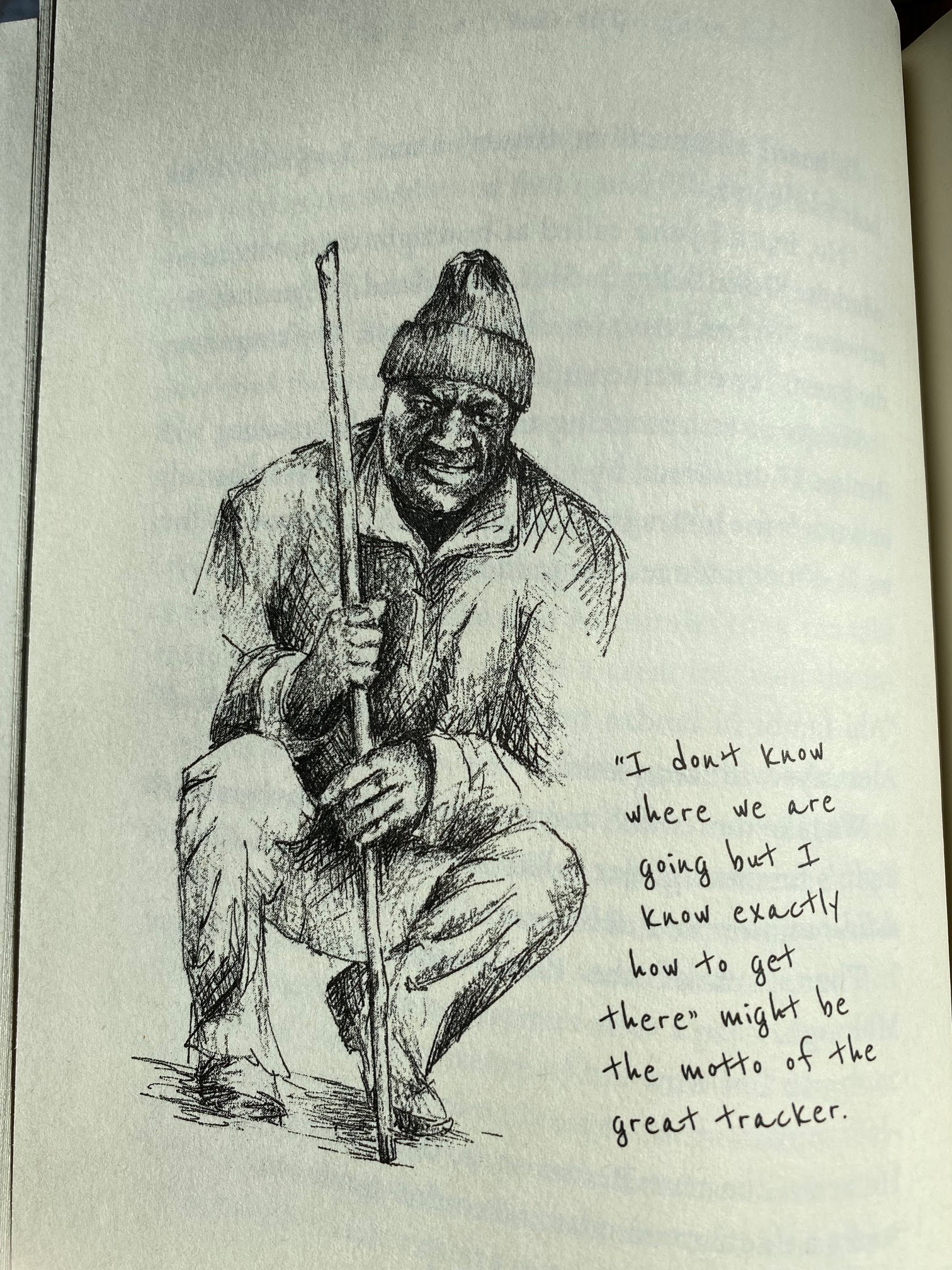
“Renias Spoke In The Ancient Language Of The Animal’s Energy” – Boyd
Boyd tells a story of Renias and Alex encountering a mother leopard who charges Alex and hovers on the edge of attack. Renias uses body language and “energy” to deescalate the situation. Boyd talks about Renias using body language, movement and the tone of his voice to create and convey a feeling.
I have observed numerous situations where a human is completely unaware of their energy when searching. While it’s important to keep your awareness tuned to your dog, you also need to feel your own presence in the search and be in conversation with your dog.
Some of the most useful ways you can speak in the language of the search are: letting go of focus on a particular place and returning focus to your dog; generating an energy of certainty (inner feeling) when your dog has communicated clearly and confidently – even if you still have doubts about the ultimate meaning of the communication; planting your feet and pivoting in place when your dog begins to change direction with high frequency and extreme pace changes; being truthful about what you know and what you don’t – for example, don’t tell your dog to get moving and go find it if you don’t know why your dog isn’t moving. Use your energy and body language to convey your willingness to patiently wait for your dog’s communication.
When you watch a human use energy and body language to be in connection and communication with their searching dog, it is generally subtle and often a reflection of what they believe the dog is communicating to them. This can look like a human following and orienting to their dog, it can involve repeating patterns of behavior from the dog and cautious attempts by the human to understand the behavior. It is not chaotic or strained, it is alive with ebbs and flows of intensity, and it is mutually enriching – even when the search is complicated and the dog and human are stretched to the limits of their shared language.
“You Must Train Yourself To See Your Track.” – Renias

Boyd shares a story of an early tracking experience he had with Renias. He talks about how fast and confidently Renias advanced on the track and how he circled tracks with his stick, but even then they remained invisible to Boyd. How does one learn to track like Renias? Boyd believes it is not a thinking problem, rather it is a feeling problem.
There may have been a time when you had no clue what your dog was doing when he searched. Maybe you just saw him walking around and sniffing, until he stopped and wanted your attention. At some point you probably recognized that his body folded over itself in a dramatic u-shape when he would pass by the odor and catch a whiff of it. Later in your journey you might have picked up on the way your dog’s tail rises a bit and softly wags as he closes in on a hide. If you’re lucky, you search with your dog and see hundreds of clues in his behavior, holding them in your mind like pieces of a 3-D puzzle, arranging and rearranging them as the search progresses.
Boyd would suggest that the ability to make meaning out of the world around you is a skill you’re born with. It doesn’t need to be taught to you, so much as you need to let yourself access that part of you that takes in information and finds causal patterns. You need to experience what it’s like to let a subconscious process do it’s thing, and what it’s like to connect your conscious self to the results of that process.
I play Jeopardy on Alexa and quite often I will get stuck on a question because I know that I know the answer, but I can’t recall it. If I’m able to relax and let go of thinking my way out of the problem, very frequently the answer arrives in my consciousness.
When I search with a dog the same process applies. If I begin to sense that the dog has communicated in a way I know I should understand, my thinking self takes action and offers lots of (un)helpful solutions, like, “oh, I bet they put the hide in that tiny ceramic house, that’s where I’d put it; or, usually this dog would have found it by now, it must be in that corner where we haven’t been…” The thinking brain offers probable guesses from past experience, not here-now communication. If I am fortunate enough to use my Jeopardy trick, quite often I will see the dog’s behavior as it really is and the answer will arrive in my consciousness. This is the training. It’s training yourself not to think!
“Nature Is The Great Equalizer.” – Boyd Varty

Boyd talks about how “nature only cares about presence, one’s ability to read the signs, navigate the terrain, and translate the language of the wilderness.” He also talks about how “no wild animal has ever participated in a should.”
In scent work, the blind search – set without meeting the expectations of the searcher – is the great equalizer. It can humble a handler, teach a teacher, and expand the possibilities for dog and human. The blind search requires of a human that he be present, read his dog, stay connected throughout the search, and translate the dog’s behavior patterns into a meaningful language – the language of the search!
No blind searcher has ever participated in a should. In the perfect training setup, the dog & his human are searching blind and the coach is coaching blind. This is the environment in which we all learn what we know and what we have yet to know. If any human knows the location of hides and is getting or giving helpful clues to find those hides, there may be many “shoulds” entertained during the search, like “we should keep searching”, “we should see if he wants to search over here”, “we shouldn’t pay yet, because he’s not right on it”… the list of “shoulds” gets very long when we are not searching blind or coaching blind.
If you make the decision to search or coach known hides, just do your best to focus on the dog and base your decisions on the communication arising from your dog.
Wether you do blind or known searches, Boyd’s advice is to ask yourself what it feels like when you are fully present and aware of {your dog’s communication}. “Learn that feeling and then start looking, not for the thing, but for the feeling. It’s there if you can tune yourself to it, if you can learn to see how the field of life is always speaking to you. Attention shapes the direction of the tracker’s life.”
“When Someone Shares With You, You Become Someone Who Wants To Share.” – Boyd Varty
Boyd is referencing his time learning the art of tracking with Renias and Alex. The sharing he speaks of in his quote is a sharing of knowledge (how to identify animal tracks and other signs of their presence); a sharing of practice (how to move as a tracker); a sharing of leadership (how to cut the track and stay on the track); and a sharing of struggle (how to be with a lost track and try to find it again).
What does sharing look like in scent work? Ideally, it looks like Boyd’s tracking experience.
As we’ve touched on many times, you can find many resources online and in person to introduce your dog to specific target odors and meet some benchmarks for your dog in the areas of confidence, clarity and reliability (CCR) to search for, locate and indicate/communicate the source of these target odors. That part of scent work is not requiring of you that you learn a new language to understand your searching dog.
When you have a dog that meets the benchmarks for CCR is when you truly begin your scent work journey. Find yourself a mentor to join you in your blind searches. Remember, you’re not selecting a mentor to set hides. Someone could be really great at setting hides, but have nothing to share with you when it comes to searching blind and understanding your dog. You want your mentor to be comfortable to lead or guide you into the unknown, to give you the feeling that you’re searching together, to be supportive and non-judgmental, to help you expand your understanding of your dog’s communication.
“Tracking Is Very Much Like Learning A Foreign Language.” – Boyd Varty
Starting on page 39, in the chapter titled “The Tracks of The Father”, Boyd describes an experience he had tracking a bull rhino without the physical presence of Renias or Alex. He writes:
“Tracking is very much like learning a foreign language. Single tracks are words. You might see a few as you walk the trail, and they create a jerky first phrase. If you stop speaking and don’t practice, the learning recedes, while the more you do it the more natural and fluid it becomes… One afternoon the short phrases became flowing sentences.”
page 39, Lion Tracker’s Guide To Life
Learning your dog’s communication in scent work is just like Boyd describes. You may get used to certain behavior changes – like the head snap or the u-turn – but those changes amount to single words. Your goal is to learn many single words, then to learn the various combinations of single words into short phrases, sentences, paragraphs and stories.
As an adult human speaking English (or whatever language you speak primarily), you still don’t have a command of the language such that you know the meaning of all the words, phrases, sentences, paragraphs and stories that could be spoken. You probably never will. So what do you do when someone is speaking to you in your own language and you don’t understand?! You might try to infer meaning from the words or phrases you do understand, maybe you’ll search for context clues, look for non-verbal communication, maybe relate what is being said to what you said prior. Or, you might ask the speaker to repeat what she’s saying, or say it in a different way. You might confess your ignorance and hope for kindness and understanding from the speaker.
As an adult human in partnership with a dog searching for target odors, you might see how a shared language is necessary to communicate beyond the most basic exchanges of information. You could try to memorize a few words and phrases for your interactions with your dog, like a tourist preparing for a trip to Spain (donde esta la biblioteca?), but, you’d be utterly lost if the conversation left the tracks you’d memorized.
So, more important than knowing every word in your dog’s language is knowing the words and phrases most searching dogs use to convey meaning, and knowing the specific words and phrases your dog prefers to communicate with. Take time to really get to know the language of the search. A good benchmark for your progress is the shift from anxiousness/frustration/rejection of communication you didn’t expect or don’t understand, to calm/interested/welcoming when you find yourself searching for meaning amidst your dog’s behaviors.
Boyd completes his story of tracking the bull rhino by sharing how he felt on the track:
“It was easy and natural and I had the feeling that I had gained entry into an entirely new dimension. I could anticipate the subtle shifts of his path, picking up the faintest of tracks like they were elaborate signs. In the same way that after months of being an outsider on a French exchange, the language comes and you suddenly belong to France, to the place, to the culture, the people. Suddenly, I was part of the story of the bush… It was more than enough for me to simply be in the experience. I realized the whole purpose of my life was manifest not as some distant outcome but here, inside an infinite state of enoughness.”
page 40-41, Lion Tracker’s Guide To Life
“The First Track Is One End Of A String. On The Other End, A Creature Is Moving.” – Tom Brown, American Tracker
Watch a scent work dog searching for an odor source and you will see a point where the dog finds a “string” of odor and begins to follow it, carefully moving along this invisible string in an s-curve, body leaning forward, head slightly lowered. Suddenly, the dog will pause, raise his head and body, then turn sharply left or right and increase pace, flicking and darting his head up and down and breathing short, rapid breaths. The dog certainly seems to be moving along a string attached to something “alive”. Can you share that same feeling and energy with your dog? Can you join in the experience of tracking the moving creature that is odor?
Boyd, Renias and Alex are tracking live animals. They are tracking where an animal has been, where it is going. They are also sensing what the animal was doing, what it was encountering. To a non-tracker the signs an animal leaves behind are lifeless and nearly meaningless. To a tracker those same signs are full of life, energy, and meaning.
Since you cannot smell the trail of odor like your dog can, you are not searching for the creature of odor with your dog. You are not encountering collecting odor or the edge of a scent cone, or a tendril of odor leading directly to source. Your are receiving your dog’s communication and aligning yourself as completely as you can with what it must be like for your dog to search for odor.
“Hi Ta Swi Kuma. We Will Get.” and “Track. Track. Track.” – Quotes From Renias
Boyd describes Renias as having “a voice inside him that motivates and builds.” Renias is not concerned with finding a lion or losing a track. He lives a process of tracking – a process that is a natural part of him.
A dog is not anxious about the future or worried about outcomes. It is our anxiousness and worry that get reflected back to us through the dog’s behavior. If you are able to relax and let go of your thoughts, you will find that your dog is much more like Renias than you are.
If you replace any concerns about time or outcomes with the phrase “we will get” AND if you truly let go of those concerns, you will find a great inner peace when you search with your dog.
What is Renias’ process? Quite simply it is to find what Boyd calls a “first track” and then a “next first track” and so on. For Renias tracking is the answer to any challenge one faces when tracking.
For your scent work dog, searching is the answer to any problem when searching. For you, observing your dog is the answer to any problem when partnering with him in a search.
When people wonder about clearing search areas (should I take my dog to that one container he didn’t pass his nose over?), about calling a possible inaccessible hide (when should I call it if my dog is still sourcing?), about speeding up their search (is it ok to tell my dog to move on from a found hide?), the answer is: let the dog search and let yourself observe the dog. Each situation is different. Applying a pre-planned action will only work in your favor by chance. You need to let the present situation develop, and only if you understand your dog should you choose an action (which may include non-action/continued observation). If you don’t understand your dog and your dog appears to be repeating behaviors/not making progress then take a break or be done with the search. Understanding will come on its own time.
“Obsessed With Perfection And Doing It Right, We Want To Go Straight To The “Lion”. – Boyd Varty

Boyd is speaking to modern western culture with this observation. We want to know exactly what we’re getting before we leave what we’ve got behind – even if what we’ve got is “soul-destroying”. It sounds trite to say life’s about the journey, not the destination. But it is true. In tracking, scent work, and life, the destination – a lion, a hide, a happy life – is just an invitation to practice your art – the art of tracking, of searching, of living – and to make a discovery.
Boyd completes the thought that headlines this section with this quote:
“We don’t realize the significance of the path of first tracks and how to be invested in a discovery rather than an outcome.”
page 49, Lion Tracker’s Guide To Life
The next time you dream of the fastest search in a competition, or you wonder why your dog isn’t going right to the hide in your group class search, consider letting go of the idea of a perfect search or “the right way” to search. Let go of the hide as the most important thing. Place your importance on the search itself, on the process of discovery.
Boyd knows the western mind all too well. He knows a person might entertain “first tracks”, and “discoveries” and the “journey”, but it won’t be long before the person asks, “but then what?” To which, Boyd would reply:
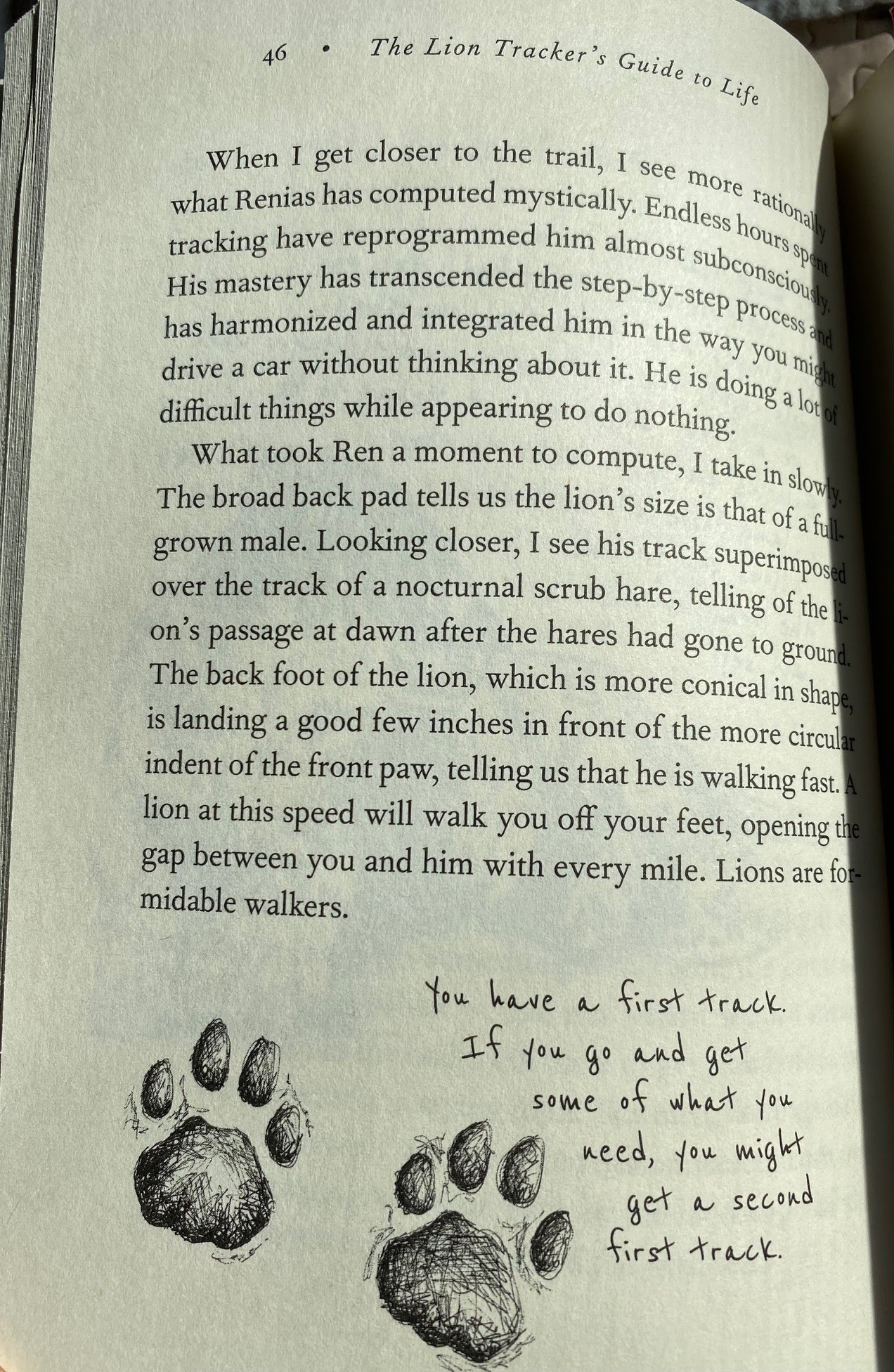
“Don’t jump to then what… You have a first track. If you go and get some of what you need, you might get a second first track.” The journey to transformation is a series of first tracks.
page 50, Lion tracker’s Guide To Life
I recently coached a human and her scent work dog, a large, floofy, warm blanket of a German Shepherd. The dog was in a barely familiar environment, and not feeling comfortable enough to focus on finding hides. The human recognized that her expectations of her dog were probably unhelpful, but she couldn’t easily let go of them – after all, her dog could find hides amazingly well at home.
We agreed that if she could trade her expectations for appreciation and just be with her dog, even if it meant not finding hides, that it would be a good “first track”. As the day went on, the human really embraced the first track and replaced her focus on the hide as the most important outcome in the search with her focus on reading and understanding – and supporting – her dog as the most important outcome in the search.
By the end of the day, her dog led her down a long elementary school hallway and she followed him without trying to guide him through a perfect or fast search. He took in the sounds and sights of people at one end of the hallway, then changed course and took her into a classroom. He communicated the presence of odor to her, then he came alive with the energy of bracketing and sourcing, fixating his huge head and nose in a desk cubby, indicating the location of the hide.
Both dog and human were happy to have shared a discovery. To have experienced a transformation. And they did it all by first tracks.
Be on the lookout for part 2. Get your copy of The Lion Tracker’s Guide To Life (I recommend the hardcover version) and support the blog.
Happy Sniffing!
 Sniff This Blog
I really enjoy how you can interpret and communicate wisdom from non-nosework sources. I loved the book!
LikeLike
Thank you! Glad you loved the book. I have a “six degrees of separation” connection to Boyd. According to someone who spent extensive time with him he is the real deal. It would be so much fun to have him come to the states and share his wisdom in person!
LikeLike
I am a huge fan of TED talks, and Boyd did a great one. Here is the link https://www.ted.com/talks/boyd_varty_what_i_learned_from_nelson_mandela?language=en
LikeLike
I love TED Talks – one of my blogs from the official K9 Nose Work blog was inspired by TED Talks – http://k9noseworkblog.blogspot.com/2014/10/ted-talks-k9-nose-work-how-jazz.html
I have watched Boyd’s TED Talk and listened to a couple interviews he’s given on podcasts. He is a great storyteller!
LikeLike