
Kenneth Deffeyes? Did I make that name up? You must know Kenneth Deffeyes! He’s that popular geologist you’re always seeing on the socials and in the media. Said no one. Ever. (sorry, Ken. Also, RIP, sir)
I discovered Professor Deffeyes in the John McPhee book, Basin and Range, but you may have heard of the professor in the early 2000s as a voice for the phenomenon known as “peak oil”. Deffeyes also wrote some books, one of which is called, Beyond Oil.
I’m not rushing to read all of Deffeyes books (definitely not in the way that I have devoured every McPhee book I can get my hands on), I simply found his quote in Basin & Range to be remarkably appropriate to the process of the formation of scent work teams. Deffeyes was examining Zeolite crystals forming in vugs exposed by a road cut – an exposed rock face made when a road is “cut” through rock; geologists love this stuff! – when he remarked on the beauty of the clusters of crystals he was seeing. He explained to McPhee that these crystals were formed very slowly, over a long period.
Deffeyes reference to the inverse relationship between speed and beauty can be examined throughout the natural world. Instantaneous events like volcanic eruptions or flash floods bludgeon the landscape like smashing a Salvador Dali and a Jackson Pollock together. While imperceptibly slow events like the rising of mountains (get this – a fast rising mountain range emerges over 2-3 million years, where’s Amazon Prime mountain shipping when you need it) tend to get truly appreciated well after their origination (El Greco, anyone?!).
Take a moment to marvel at the fact that we are walking around on solid ground floating on super-heated metal with the viscosity of caramel (might there be a giant, tart green apple at the center of the earth? That would be a great twist to the Genesis tale!).
Take another moment to bask in the unbelievability of the fact that salt explodes rocks. Boom! Could I sweat my way out of a rock? (crikey, is rock salt the name for salt that has exploded rocks?! Investigation pending).
While we’re engrossed in important human stuff, the universe is playing the long game, one that we can’t even fathom, even though we have science and whatnot. In the mere 12 seconds of earth’s total existence that humans have been mucking about, we’ve managed to wrap the earth in plastic and irritate the arctic ice (think earth’s sphincter) enough to release huge farts of methane gas into the atmosphere. Yay, humans! We live short lives, I suppose it’s only natural that we be short-sighted.
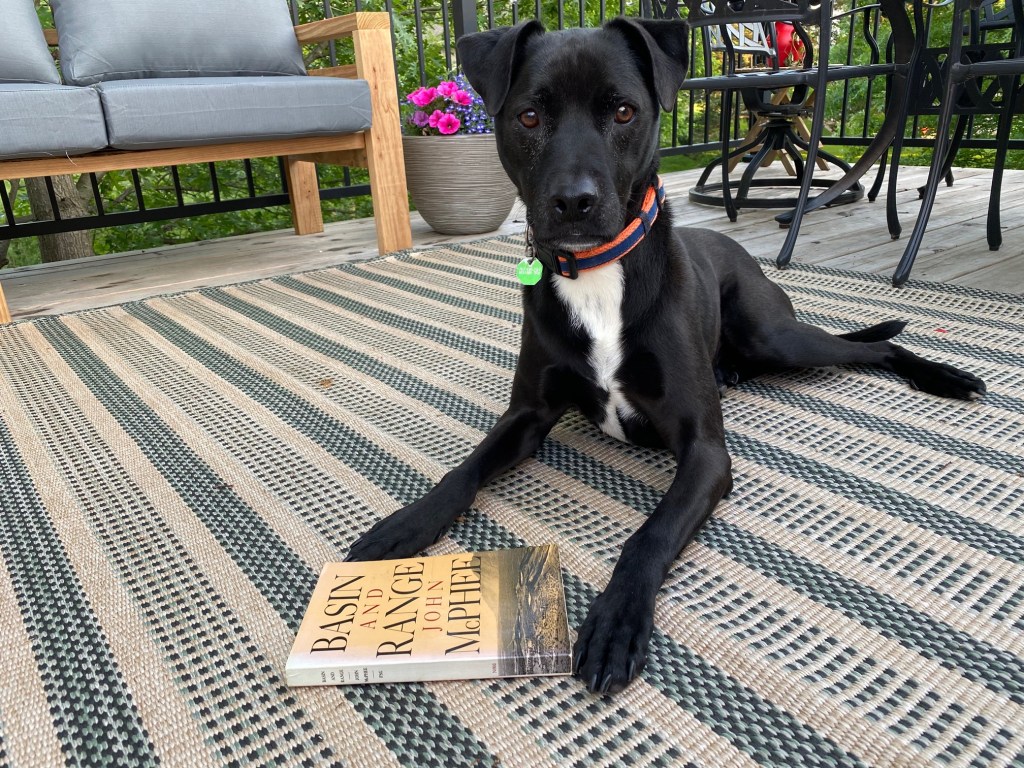

smells like a good book, though.

The Zeolites of Scent Work
When folks ask me about starting a dog in scent work, I think about the teams that I admire most, and what the process has been like for them. Even if a team arrives on the scent work scene with pyroclastic flair, it is the slow and steady revealing of what is at their core, like the exposure of an ancient seabed over millions of years, that really grabs me. In short, no matter what the beginning is like for a scent work team, I’m patiently waiting for the next deepest layer. It’s the slow moving processes that tell the story.
I really enjoy a team that starts scent work before they even start scent work. A team who builds a genuine bond, who creates the language of relationship in everything they “do”, even if all they “do” is share a life together (is there anything more important?!).
Like a slowly forming stalagmite, a scent work team can grow from the ground up with the simple act of classical conditioning, using odor at meal time or combining odor & food for a handful of exposures of the “shell game”. The power of this pairing cannot be understated. Like a Zeolite crystal with the surface area of a bedsheet compressed into the size of a pinhead, a dog’s olfactory system can become densely populated with excited neurons charged by the food-odor combo. It can seem like nothing is really happening in this phase of scent work, but once the dog is really hunting, you’ll see the evidence of this experience in the dog’s later searching style, like the colored layers of sedimentary rock marking the geologic time scale.
Shifting to the more instantaneous events in the genesis of a scent work team, the “choice game” most certainly is the equivalent of volcanic activity. Assigning value to the scent source by reinforcing the dog’s decision to connect with, focus on, and communicate the presence of said source produces as striking a result as obsidian formed from rapidly cooling felsic lava.
It’s fitting that geologists love road cuts, which provide them easy access to geologic wonders that might not be revealed naturally for millions of years. Dogs working scent provide a “road cut”, revealing the invisible realm of fluid dynamics through their body language. Just as geologists quickly learn about the aspects of our earth that have been revealed to them, yet merely speculate about that which remains too removed from careful examination to truly know anything about, handlers tend to learn the obvious about scent movement and the properties of certain types of environments. But, as any long time handler will share with you, mysteries abound in the world of scent – not magical phenomenon, just things we have not encountered often enough or clearly enough to study and master. It is this combination of easily available information and easily sucked into black holes of mystery that lure so many people into the world of scent work.
If the most beautiful teams in scent work are formed slowly, they need to be sheltered from destruction; just as the Zeolite crystals form in vugs (holes in the rock that resemble tiny caves), slow forming beauties of scent work need their domiciles for development. If wind, rain, and sun are the instruments of degradation in the geologic realm, then overtraining, over-competing, and underdeveloped communication are the destructive elements of the scent work ecosystem. Take in the fact that rivers are changing, mountains are changing – you are changing – constantly, but at a rate that can only be appreciated across a long enough timescale. Do not put or keep your scent work team in “training” because it makes you feel better about your progress. Trust that even during times of perceived inactivity, beauty is in the process of being formed.
“In a lot of valleys in Nevada all you will see is sagebrush, and not know that eight feet below you is a hell of an interesting story.” – Deffeyes
A theme throughout Basin and Range is the unseen, unknown story of the earth. Sure, there are places on earth where we can clearly see layers of sediment and rock describing ancient seas, fissures and veins telling of deposits of ore deep beneath the surface, upheavals of collided land masses mapping out the ancient movements of tectonic plates. But, so much of earth’s story is hidden – even from geologists. Hidden in vast mountain ranges, hidden in the depths of the seas, hidden just beneath the sagebrush. If you have no interest in geology, the thousand page story of the earth might appear to you as a one page summary consisting of what you can see with your eyes when you step outside.
Every aspect of scent work tells a story. What you see depends on what you think might be hidden from plain sight and what you’re willing to go searching for. Do you know your dog’s “geologic history”? The ancient, fertile seas that are now vast deserts, the slowly building mountain ranges, the past collisions with other “land masses” on his planet. Do you know your own history? Are you interested in looking for hidden information? Do you see the scent work game as a simple sport, or do you wonder what lies beneath the surface of start lines, boundaries and time limits? Do you want to search in fields of sagebrush, or do you want to search a bit deeper? There could be “a hell of an interesting story” waiting for you.
“It is a wondrous thing to have the random facts in one’s head suddenly fall into the slots of an orderly frame-work. It is like an explosion inside.” – Deffeyes
So much of geological discovery is a process of diligently collecting information and doggedly searching for ways to arrange that information into a story of the earth’s formation and transformation. From the discovery of angular unconformities to the concept of plate tectonics, the earth’s story has been full of twists, turns and mystery!
Each scent work search is it’s own tale of transformation, with the dog describing edges of odor, concentrations of scent, and the handler trying to follow along, to arrange the puzzle pieces into a revealing image. Quite often, a complex search feels like collecting puzzle pieces from different puzzles, with nothing fitting together, until a piece is discovered that makes everything work in a flash of understanding. An “explosion inside”.
“Range after range – it is mysterious to me. A lot of geology is mysterious to me.” – Deffeyes
This closing line of a lengthy (and fascinating) quote should be the mantra for every would be expert. Here is a geologist with decades of experience – a field researcher, as well as a professor – and he is mystified by his subject. Lovingly mystified.
The most beautiful teams in scent work are lovingly mystified by the game. Even as they advance in the study of cones and plumes, pools and edges, trails and sources, these dogs and handlers revel in the mystery of the unseen. Be it the turtleback mountain formations at the edge of Death Valley or a scent eddy between two vehicles, there is an invitation to engage in Holmesian deductions, piecing together a puzzle across time and space, one that you hope to never find all the border pieces to.
If you’re enjoying these posts, support the blog by donating or getting a copy of John McPhee’s Basin and Range.
Happy Sniffing!
 Sniff This Blog
This blog describes beautifully why working with K9 search and rescue teams was so addictive. One was able to work cooperatively with skilled dogs and handlers on solving complex problems for the benefit of others on a large scale.
It also reminds me of some weekend trips into the open mine pits on the Cuyuna Range with my father, a mining engineer and amateur geologist. He loved finding agates and a rock now known to be an agate but at the time thought to be a replacement of iron or asbestos with quartz, called Binghamite or silkstone. It’s a rare, semiprecious stone found on the Cuyuna Range and almost nowhere else. https://www.flickr.com/photos/jsjgeology/22917986494
LikeLike
Thanks for reading and commenting! Love the story about agate hunting in the Cuyuna Range. We visit Cuyuna several times a year for the beautiful mine pit lakes and the fantastic mountain biking trails. We’d love to spy some silkstone when we’re up there!
LikeLiked by 1 person
Another rare Minnesota rock that might be easier to find — and is closer in line with this blog — is Thomsonite found along the north shore of Lake Superior. https://www.thomsonite.com/thomsonite
LikeLike