
Verse 78 is our random verse for the day:
Under heaven nothing is more soft and yielding than water.
Yet for attacking the solid and strong, nothing is better;
It has no equal.
The weak can overcome the strong;
The supple can overcome the stiff.
Under heaven everyone knows this,
Yet no one puts it into practice.
Therefore the wise say:
“If you take on the humiliation of the people, you are fit to rule them.
If you take upon yourself the country’s disasters,
You deserve to be the ruler of the universe.”
The truth often sounds paradoxical.
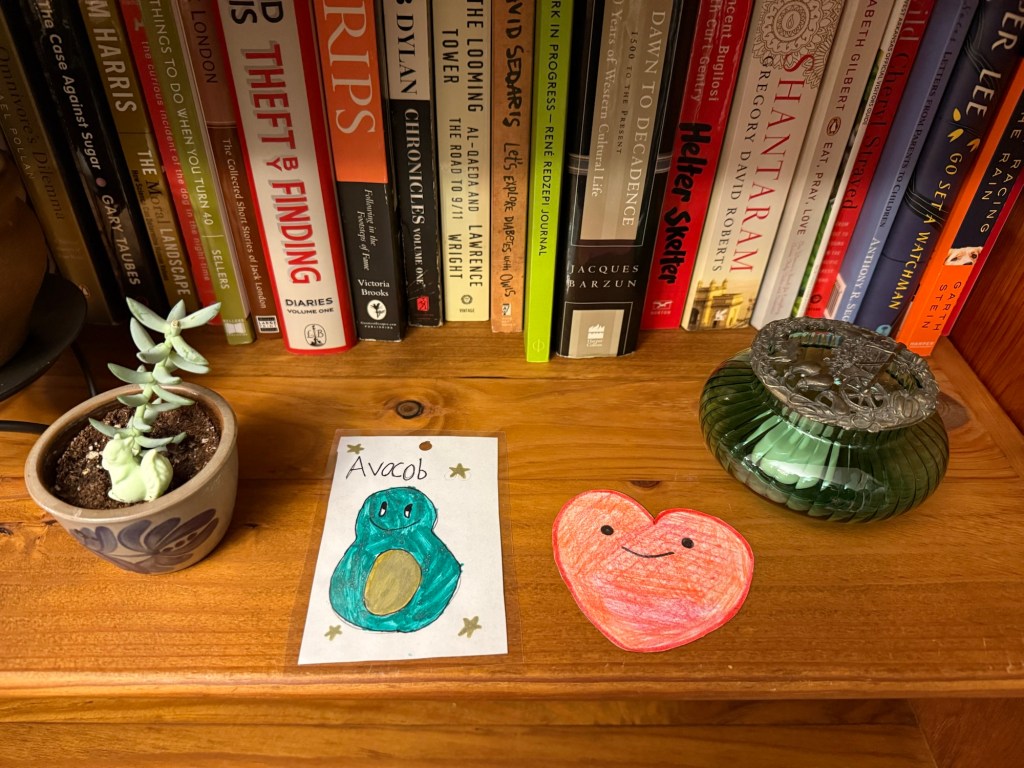
Instead of breaking down this verse line by line, I’m going to share something with you that could be seen as mere coincidence, but I prefer to receive it as the mystery of connection: I did choose verse 78 randomly, but it wasn’t my first random page turning. On my first flip through the book I landed on a page with a couple of bookmarks in it. A smiling heart and an avocado. These are custom creations by my daughter. I thought about the heart and the avocab (as my daughter would say when she was little), and when I read the verse my heart was not filled with light. So, I closed the book and gently curved the pages, releasing them from front to back and stopping randomly on verse 78. Yes, my heart said. That’s it. But why? I typically find all verses of the Tao Te Ching to be pleasant to meditate on. I marked the page and stood up, brushing off my inner voice’s soft invitation to listen more deeply.
Moments later, sitting at my computer with verse 78, my inner voice said, “this isn’t it.” Again, I never have a moment of hesitation writing with the Tao Te Ching as my guide. Strange as it was, I chose to listen more closely this time. I noticed my desk chair was covered with a couple of jackets, a beanie and a pair of gloves, and I hadn’t so much sat in my chair as planted a knee at one edge and steadied myself in a single leg squat. Uncomfortable to say the least. I looked at one of the plants on my desk and he seemed sad, a number of his leaves pale yellow and brown. He seemed to need my attention. I left my desk and found a book I’d recently picked up from Goodwill, a book called “Plants are Still Like People”, by Jerry Baker. I thumbed through the houseplant section and considered that this plant on my desk might be experiencing a draft, as my desk is next to the patio door. Thinking about this little houseplant and his needs, I wondered again why I was struggling to connect with verse 78 of the Tao Te Ching. Maybe the Tao wasn’t what I should be writing about at this moment.

I put my writing aside, made some tea and let myself get lost in some of life’s other attractions, including a delicious bowl of yogurt, seeds, fruit and chocolate, a few errands completed with the help of my newly driver’s-permitted son behind the wheel, and some classically endearing and hilarious episodes of Flight of the Conchords watched with my daughter. Then, I went to bed.
The next morning, I thought, “I want to get this writing about verse 78 done.” But, that’s as much as I could muster – a thought about getting it done. Instead of taking action on the writing, I finished a book on listening to nature, which included a section on grief. It got me thinking about the many dogs I’ve befriended who have passed away. I used to experience a deep and painful grief, but now I don’t. I wondered if something was wrong with me. The book suggested that the pain we experience in grief is not the breaking of the heart or the loss of a piece of it, but the growing of the heart, a growing into universal compassion and love. I think that explains it well enough for me. I no longer experience the loss or pain, just the love – which can be mournful, but sweet.
I finished the book, which I’d been reading through kindle on my phone, and I realized I’d not plugged my phone in the night before. As I placed my phone on my nightstand to charge, a white and yellow hardcover book caught my eye, “The Te of Piglet”, by Benjamin Hoff. I hadn’t opened the book for over a week. Something told me to sit down and take a look at it. So, I sat on the floor next to my bed and opened the book to the page I’d marked. Here is what I found:
Many descriptions have been written of M.K. Gandhi and his Truth Power movement. But our favorite has never, we believe, been quoted. It was written by Lao-tse centuries before Mohandas Gandhi’s birth, in chapter after chapter of the Tao Te Ching:
Nothing in the world is more yielding and gentle than water. Yet it has no equal for conquering the resistant and tough. The flexible can overcome the unbending: the soft can overcome the hard.
It was an alternate translation of the opening of verse 78! The bookmark I used for this book is a “dog ear” bookmark. This book came from Goodwill and stuck between the pages was a black and white photograph of rock and water. Immediately, I went to my computer and cleared my chair. As I sat down and opened my laptop, I noticed something different about my desk. The sad plant was gone. Rachel had moved it to a new location. Already, the plant seemed happier. I began to write effortlessly and with great curiosity.

I could tell you what I think Lao Tsu wants you to know about Tao from verse 78. But, I think we all need to hear from Piglet, instead. Or rather, we need to hear about Piglet. See, Piglet is what Ben Hoff calls a “very small animal”. And, as a very small animal, Piglet isn’t accustomed to getting people’s attention, or to getting into people’s business – he hardly wants to get into his own affairs. Piglet represents a great many beings. These are the beings who are not, as Tigger is, loud, over-confident, do-it-alls; or as Eyeore is, loud, constant complainers; or as Rabbit is imposing, clever meddlers; or as Owl is, always over-confident know-it-alls. They are also not as Pooh is, free from the constraints of the ego, content to simply be. Piglet represents the hidden potential of the underdog, the stuck-in-the-middle nobody who wants to be SOMEBODY… but, not too loudly or noticeably. Maybe, not at all, on second thought.
Piglet is unrealized power – hidden, even from himself. Piglet is the unsung hero, the overlooked solution to the unsolvable problem. Piglet is water. And this is why it’s often so hard to be Piglet. He seems so fragile, so unable, so pitiable. No one really wants to be Piglet. Piglet agonizes. There’s so much he can’t do, won’t do. There’s so much so little. Yet, everyone knows that Piglets do have potential. A Piglet’s potential power is not evident in his voice, or his movement – it’s not on display. There is grace and wisdom in such power, and as it happens, so much-so little-so often is necessary for so much to be done when no one else can do it. Piglet is patience, persistence, and he means no harm. His power comes from his truth. He does not go around looking to be something, to be someone he isn’t. He does not look for situations to assert himself and prove himself. He is not out to vanquish an enemy, to fight a battle, or to enact revenge. Piglet’s power is in his ability to conform to his nature, which is naturally formless.
Bruce Lee immortalized the phrase “be like water”. We all know it. We all know it means we have the power to overcome the greatest adversary through yielding. Yet, as Lao Tsu writes, “no one puts it into practice”. Perhaps it is because the power to overcome is realized through transformation. And it is transformation without transforming – like water, changing form and state dependent upon the surrounding environment; form and formless – that feels so scary and seems so impossible for most beings. Very small animals, like Piglet, or Gandhi, aren’t destined to transform and triumph, but they have the power, if they so choose.
Of all the ways of being, it is the Piglet Way that keeps space for observation, leads with humbleness and contemplation, and has the potential for virtuous action. It’s Piglet that can transform like water. If we humans play with the fluidity of the Tao, the Way – the transformative power of Piglet – in the arena of nose work, we increase the odds that in our daily lives more than one among us will answer the call to be so much in times where no one else can.
I’ll leave you with this song Piglet sings at the closing (or beginning) of The Te of Piglet:
Let’s find a Way
Today
That can take us to tomorrow –
Follow that Way,
A Way like flowing water.
Let’s Leave
Behind
The things that do not matter,
And turn
Our lives
To a more important chapter.
Let’s take the time,
Let’s try to find
What real life has to offer.
And maybe then
We’ll find again
What we had long forgotten.
Like a friend,
True ’til the end,
It will help us onward.
The sun is high,
The road is wide,
And it starts where we are standing.
No one knows
How far it goes,
For the road is never-ending.
It goes
Away,
Beyond what we have thought of;
It flows
Away,
Away like flowing water.
If you receive something from this blog, consider giving by making a purchase (any purchase, actually) of the The Te of Piglet or The Tao Te Ching using the affiliate links. Or donate directly to the blog.
Happy Sniffing!
 Sniff This Blog
Leave a comment