
When you click on the links in these posts your purchases help support this blog. You can also support the blog by clicking here.
In nosePlay: Part 1, we took a peek at Stuart Brown’s book Play and learned about the properties of play (although Brown would rather not define play), the “wheel of play”, the purpose of play, and more. People and dogs are major players, a trait owing to the lifelong juvenile tendencies of both species. People play to build their brains, and they build their brains for their entire lifetime. Most importantly, we learned that play is fun. It is the kind of fun that is not contingent on outcomes or analysis (self-criticism or judgement). Play is a state of mind.
In part 2, we consider the major play personalities, we look at different types of play throughout the life of a human, and we explore the dynamics of playing together.
With 40 years spent researching play in animals and humans, Dr. Brown leaves no room for questioning the importance of play across the animal kingdom. Play is not just fun, and cool, it is a powerful creative force for the health and growth of nearly all animal life. The benefits of play are too great to miss out on. You need to support your dog’s desire to play and you need to cultivate your play-based nature, because your time together with your dog is too short not to make the journey fun.
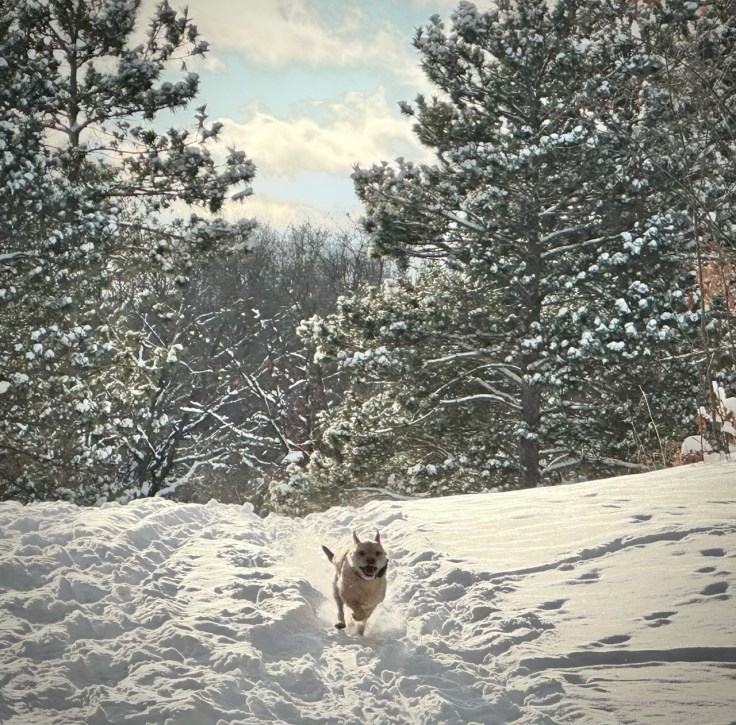
PLAY PERSONALITIES: There are eight general play personalities, and Brown describes them beginning on page 65 of his book. Adults tend to show preference for a particular style of play, with less openness than juveniles. A person can be a mix of categories, but generally will have a dominant play personality type. I believe these categories can be seen to some degree in our dogs, too.
The Joker – Dr. Brown says this play personality revolves around nonsense, like a parent using baby talk to make their infant laugh. Class clown and practical joker fall into this category of play. It’s silliness and making others laugh. Some dogs are real hams, making everyone laugh with their antics. I know a dog named Pistachio whom we describe as a circus clown. He not only finds odor, but he finds the most silly and acrobatic ways to get to it. His human laughs a lot when he searches.
The Kinesthete – I self describe as this play personality. I love to move, to interact with the world around me. When I was younger I would find the tightest spaces to fit myself into, I played all the contact sports, and I would spend hours jumping rope, tossing a ball up and catching it, throwing rocks into the pond, running in the woods, riding my bike – I loved to move. Today, I am frequently the only adult scrambling up the side of a tower, chasing after my kids at the playground. Some dogs have to contact everything with their body. They have to squish into every tight space, walk over every strange surface, jump onto every ledge, smoosh into every leg or lap. My dog Muriel matched my play type. She would disappear under vehicles, leap into bathroom sinks, balance on ledges, and march over metal grates as she searched for hides. My young family dog, Miles, has this play personality, too. Lucky me!
The Explorer – Brown notes that “each of us started our lives by exploring the world around us. Some people never lose their enthusiasm for it.” As Brown sees it, “exploring can be physical – literally, going to new places. Alternatively, it can be emotional – searching for a new feeling or deepening of the familiar, through music, movement, flirtation. It can be mental: researching a new subject or discovering new experiences and points of view while remaining in your armchair.” I believe we all retain the explorer play personality, maybe some of us just tend to express it in solitary. Dogs join us as highly exploratory beings. When Brown uses the phrase, “searching for a new feeling or deepening of the familiar…” I am struck by how many dogs I’ve known who generously offer their expert guidance into this realm of play. Even though scent work offers the dog the opportunity to hunt for a target odor, for the most enthusiastic explorer personalities, the world is just too rich a playground to narrow it to one point of interest. Make sure you don’t rob your explorer dog – and yourself – of precious play experiences.
The Competitor – So much attention gets placed on this play personality in the adult world. The competitor likes to be #1 at a specific, rules-based game. It can be a video game, a sport, or a nose work trial. The competitor puts time and energy into performing at a high level, whether it be rock climbing, football, or nose work.
Here’s the thing: the competitor is a play personality. Play. Brown is not describing competitors who are self-critical, judgmental, or who get fixated on outcomes. Brown is not describing slaves to repetitive practice or drills. He is describing someone who is most at play in the arena of competition. Someone who may or may not have developed skills conventionally. The competitor play personality type may be best embodied by someone like Patrick Mahomes, Alex Honnold, or Simone Biles. And it could also include a kid who loves dodgeball, or a chess enthusiast, or a trick shot artist, or an avid reader. You don’t have to be the best in the world to have a competitor play personality – you can also be the best you.
Think very carefully about if you and/or your dog have the competitor play personality. It’s not as common as it seems. What is common is the cultural marketing campaign to convince everyone that they are the competitor type. There are 7 other play personalities that may better define you and your dog.
The Director – Brown lists Ina Garten and Oprah Winfrey as director play personalties. He describes this play personality as the “organizer”, the “party giver”, and, at their worst, the “manipulator”. At play, this personality type can bring others together to create events that bring joy to all. Directors are often connectors, bringing people together and building communities. While there may be some dogs who like to call the shots and run the show, the director play personality tends to be most obvious in humans.
The Collector – Brown lists the typical things one could collect: purses, toys, coins, wine, shoes. He also includes experiences among the things a collector accumulates, like a person who travels around the world to collect solar eclipse viewing experiences. Or, I’ll add, a person who collects titles, ribbons, points, or trial attempts in nose work.
I call some dogs treasure hunters – they could easily be called collectors. These are the dogs that revel in the discovery of all manner of bric-a-brac, often digging an item from its hiding spot and briefly mouthing it before displaying it on the ground for all to see. Given some time and incentive, these dogs often make the choice to focus on target odor hides as their most valued prize, becoming prolific and playful nose work collectors.
The Artist/Creator – You or someone you know probably enjoys painting, knitting, scrapbooking, rebuilding old car engines, making furniture, or creating clever costumes for halloween. A lot of people have artist/creator play personalities. You might be famous or wealthy through expressing this play personality, or you might enjoy this side of yourself privately. “The joy is in making things”, says Brown.
Many dogs strongly express the artist/creator play personality. Brown writes, “the point is to make something – to make something beautiful, something functional, something goofy.” A dog allowed to express himself through the medium of searching for a target odor is like a painter. The dog creates a picture through movement and expression. It is not a lasting thing, it’s more like sand art at the edge of the surf, here one moment, washed away the next. The dog is an artist. The thing about art is the artist gets to make it, and they don’t need to make it for you. If you get the sense that your dog is an artist/creator play personality, then you are more of a patron than a partner. Support your dog’s artistic nose work creations.
The Storyteller – Brown includes both the creator of the story and the reader of the story in the description of this play personality. Dancers, writers, magicians – any performer – are all examples of storyteller play personalities. Imagination is the magic ingredient of the storyteller. Do dogs use “imagination” in the way we think of it? Maybe. Science definitely makes the case for dogs to possess the brain functionality, emotional complexity, and self-awareness needed to make imagination likely – even if it is only faintly similar to the human experience.
If we can’t quite say whether dogs possess the storyteller play personality, we can certainly say many humans do. Storytellers can imagine a nose work search is like a special mission to save the world, or like a treasure hunting adventure. Storytellers can make meaning out of a nose work search. When you combine a dog with an artist/creator play personality and a human with a storyteller personality, the play possibilities through nose work are endlessly and deeply satisfying.
“When We Stop Playing, We Start Dying” – Adults have different play styles than children, but the more important difference is that adults lose touch with what play is. They can become confused about when, why, and how to play. In Play, Brown suggest that it is harder to tell what “adult play” is, that often, adults turn play into work, and work into play. We read about the Pebble Beach golfers, miserable at “play”, in part 1 of this blog series. Brown also talks about Jonas Salk and Roger Guillemin, two scientists who treated their laboratories like big sand boxes, and spent their days giddy as children with very expensive “toys” they got to play with as they tried to change the world for the better. Brown also tells a story of two brothers working at their family junkyard, and the fun they would have racing to see who could build the biggest stack of carburetors, or break down and rebuild a generator the fastest. Work becomes play.
How do we know if we have stopped playing? It’s easier than you might think. You get stuck in fixed behaviors. You lose interest in novelty. You find true pleasure in fewer and fewer experiences. You lose the vitality, playfulness, and humor of youth.
It’s never too late to repair yourself and reconnect with the vitality of a life at play.
Want To Live A Playful Life? Make A Child Your Mentor – Brown details the stages of life from neonatal through adulthood through the lens of play. Kids – especially without adult supervision – are masters of play. How did they get that way? Evolution strongly favors playfulness as a way for “the brain to build the brain”. Play prepares us for the complexity of the world. The following are play stages throughout the life of a human (find them beginning on page 81):
Attunement – This is the eye contact, the co-creative babbling and cooing that an infant and a parent experience. Brown writes, “both mother and baby are synchronizing the neural activity in the right cortex of each brain. If we wired Mom and baby and took an electroencephalogram (EEG), you would see their brain currents are actually in sync. This is called “attunement”.”
If you and your dog don’t get the feeling that you’re on the same wavelength, you might want to focus on attunement, or what Brown calls, “the most basic state of play… a foundation for the much more complex states of play that we engage in throughout life.”
I really enjoy spending time just being with my dogs. Finding out the kind of physical touch, the kind of eye contact, body posture, and mimicking that we both enjoy and connect through. Especially in nose work, being able to listen to and be present for your dog ensures you a relationship that training alone just can’t give you. When you have attunement, you feel mind-melded with your dog. This is a wonderful way to be and essential to a mutually enriching search experience..
Body and Movement Play – As Brown states, “this play program really starts in the womb.” Babies and toddlers are all about movement. Through movement they explore and learn about the world and themselves. Dogs are also very movement oriented learners.
While nose work seems to be a great way for dogs to build confidence in novel environments, it is not a panacea. A dog can benefit greatly from movement play with and without a human – play that is focused on fun exploration of different objects, surfaces, sounds and activities that may be present in novel environments.
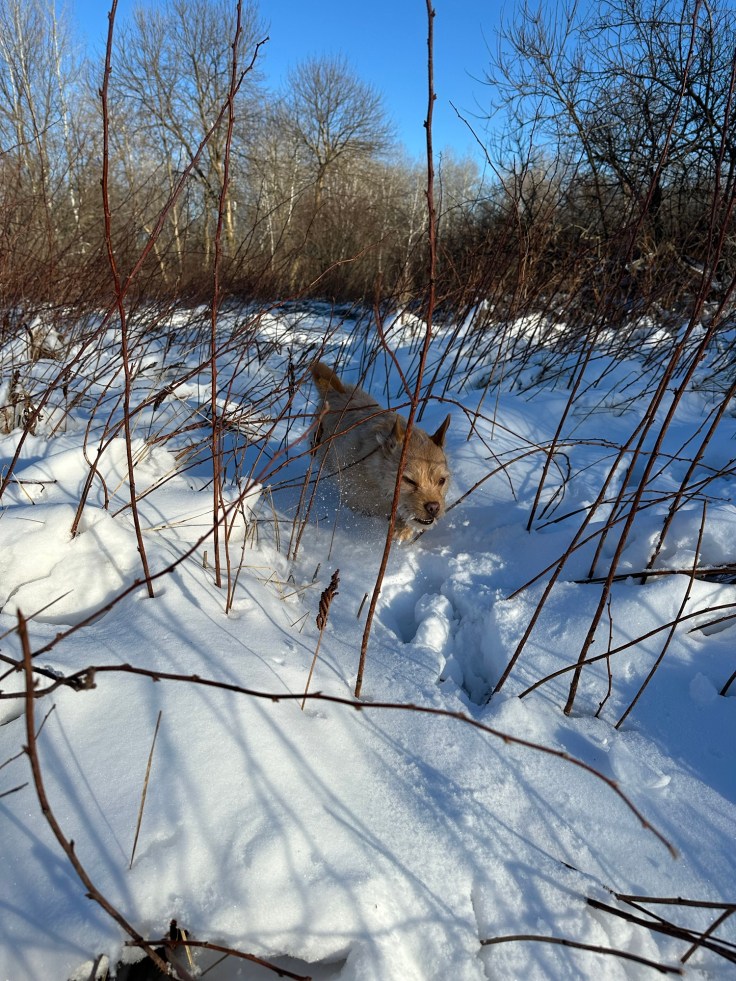
Object Play – The play police have some laws regarding object play in nose work. No box pawing, stomping, biting or kicking around. No poking of one’s muzzle into someone’s training bag. No pushing open of bathroom stall doors. No dislodging of hides and flinging of hides across the room. Fine, whatever… There are certainly limits we want to place on the destructiveness or danger of object play, but the neurological benefits are so powerful, limits should be thoughtfully applied.
Imaginative Play – In kids, this is often called “pretend play”. I used to play doctor, soldier, air force pilot, pro golfer, chef (I made a delectable mud pie), etc. In adults imaginative play is more often the act of “playing out scenarios” to manage the complexities of life. The many hours I’ve spent bass fishing have included lots of imaginative play relating to the lunkers that got away.
We touched on the possibility of dogs using imagination. I think they do seem to imagine what it might be like to pursue certain paths to source odor. This occurs before sourcing, and sometimes after sourcing. We humans use the words, “he’s playing with the odor” to describe a dog who is engaged with the scent, but not seeming to quickly and directly go to source. I have encountered a non-trivial number of dogs who are searching and moving through space, only to come to a complete standstill, their eyes darting around; maybe these dogs live a bit more in the realm of imagination than others.
Social Play – Brown considers this type of play so integral to human life that he breaks it down into subgroups: friendship & belonging, rough & tumble, and celebratory and ritual play.
friendship & belonging: As I age, I feel the strong pull to connect with a tribe of individuals who share my values. I want to be part of building and participating in a community. This is true in my general friendships, in my passions and hobbies, and in my work. I believe that dogs are capable of friendship & belonging, too. When we pull back the veil of control and give a dog the opportunity to teach us something and enrich our lives, then how else can we describe their generosity and connection, but to call it friendship? Dogs are social mammals, so belonging is high on their list of needs. Nose work is so naturally suited to social play, and dogs are ready and waiting, one just needs to make the choice to join in the fun.
rough & tumble: Oh, a play style I LOVE. Brown calls this play “necessary for the development and maintenance of social awareness, cooperation, fairness, and altruism.” Yes! A respected doctor said we can hit each other for fun! For those of us who engage in rough & tumble play, the benefits are obvious. And this is true across species. Dogs engage in rough & tumble play from puppy throughout adulthood. It is natural and essential.
Dr. Brown goes on to say, “Its nature and importance are generally unappreciated particularly by preschool teachers or anxious parents, who often see rough-and-tumble play behavior such as hitting, diving, wrestling (all done with a smile, between friends who stay friends), not as a state of play, but a state of anarchy that must be controlled.” Surprise! The play police want to control something because they don’t like the way it makes them feel. Worse, the play police claim they don’t like rough & tumble play because it will lead to aggressive behavior, or because someone will get hurt.
This is a good time to go on a brief tangent: rough & tumble play isn’t the only thing the play police don’t like and try to control. The play police don’t like anything that makes them uncomfortable or that has an unknown outcome. In nose work, the play police might not like that a dog is getting too “aroused”, or that a dog is acting in ways that don’t seem like “searching”. If you leave the dog be – or accept the dog’s state of being – quite often there is nothing you need to fear and nothing you need to control. But, play police will swear that a dog has to be protected from his own nature and can’t be allowed to make choices that will be bad for him. This is a false narrative pushed by the same people who would label rough & tumble play as “too much” and decide to stop it and “teach” everyone to behave. I’m not interested in behaving for someone else when there is no good reason to do so (note, I will certainly react for good reason, if a dog or human is truly in danger or a danger to themselves or others).
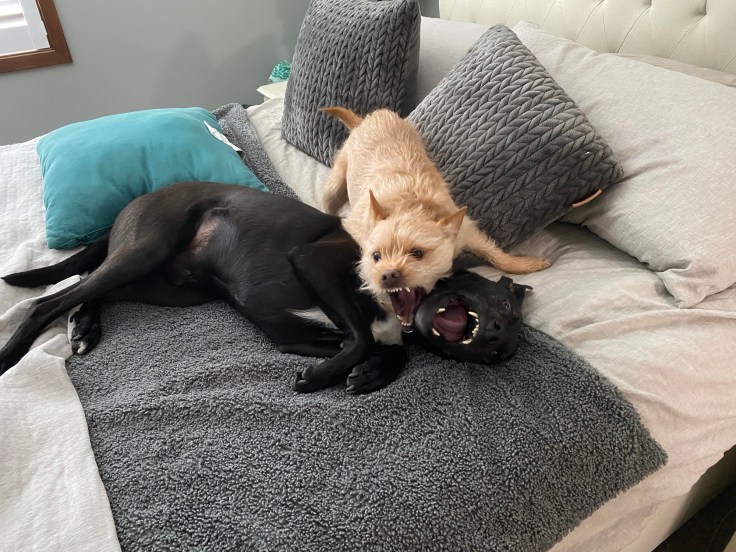
celebratory and ritual play: Dr. Brown describes this play state as “necessary both to provide an “official” excuse to play and to keep this play pattern under social control.” Brown notes that “children don’t spontaneously initiate these events…”, which places this kind of play more in the adult realm, serving to bring order to instances of play, like a reception after a wedding.
In nose work, most dogs are happy to join a human in celebratory and ritual play. And, because this is a more adult state of play, most humans at least try to incorporate this play into their search experience. Competition often chips away at the duration and frequency of celebratory and ritual play, so it’s important to remember that outside of competition you can really savor and enjoy this state of play as long and as often as you and your dog like.
Storytelling and Narrative Play – Storytelling and meaning making are uniquely human. Brown says, “Storytelling has the capacity to produce a sense of timelessness, pleasure, and an altered state of vicarious involvement that identifies narrative and storytelling with states of play.” Nose work is all about telling stories. If you ask someone what happened during a search with their dog, the person will often weave the events together into a narrative, and fill in details that can’t be verified, creating a story. Creating narratives and stories helps a person to explore the possibilities for why something is the way it is. For example, when your dog won’t search the way he normally searches, you can just ignore it, or you can start building stories for what is going on. Just like science uses hypotheses to guess at how something will work, stories are another way of coming up with guesses. As long as you treat your stories as tools for understanding the world, versus truths you must uphold and defend, you can have a great time searching with your dog and making meaning together.
Transformative-Integrative and Creative Play – I think of searching as an opportunity for dog and human to co-create a shared language which can be used to have meaningful conversation. Part of the conversation of the search involves stepping beyond the limits of the shared language and growing the shared language together. It is this commitment to co-creative play that, as Brown puts it, “…can become a doorway to a new self, one much more in tune with the world. Because play is all about trying on new behaviors and thoughts, it frees us from established patterns.”
So many adults are stuck in their patterns – not stuck, they cling to them – and they like nothing more than to stick others in patterns, too. A pattern is great when it acts as a springboard to something new, it’s not so great when it acts as a shackle, holding you back. The game of nose work does not need to be drilled into a dog through pattern training. The game of nose work is the ultimate pattern disruptor. It is the greatest transformative-integrative play a dog and human can do together.
Learning And Memory – “As we grow older, we are taught that learning should be serious, that subjects are complicated.” Says, Dr. Brown. “These serious subjects take serious study, we are told, and play only trivializes them.” I have come up with a lot of nose work games over the years. Selfishly, the games were a fun way for me to learn about the dog-human relationship in nose work. Thankfully, the games were also fun to play for all involved (well, maybe not fun for the person whose dog knocked her legs out from under her while she was running, causing her to chip a tooth on the asphalt!). Dr. Brown says, “Play isn’t the enemy of learning, it’s learning’s partner.”
Most people enter the world of nose work with an openness to the idea of doing a fun activity with their dog. But, given enough time in the game, the very adult trait of not wanting to be wrong begins to derail the fun. Brown points out that kids, “aren’t afraid to just try stuff out and see what works… kids don’t fear doing something wrong. If they do, they learn from it and do it differently next time.” Strangely, adults both fear doing something wrong and fail to change their behavior next time. Maybe it’s the lack of playfulness during learning. Brown highlights that “Learning and memory also seem to be fixed more strongly and last longer when learned in play.” He goes on to say, “play involves multiple centers of perception and cognition across the whole brain.” And brown quotes psychologist Stephen Siviy, on play and the brain: “Play just lights everything up”. It’s a good chance that adults who are unable to be at play when learning how to partner with their dogs in nose work may not be able to learn very well. Play is the way!
Gifts Of Play – Play is intrinsically rewarding. If you’ve ever picked up a bubble wand and started blowing bubbles onto the breeze, there is no thought of why you’re doing it beyond the pleasure of the experience. Isn’t it amazing that play bears many more gifts than merely being pleasurable.
“Authentic play comes from deep down inside us. It’s not formed or motivated solely by others. Real play interacts with and involves the outside world, but it fundamentally expresses the needs and desires of the player. It emerges from the imaginative force within. That’s part of the adaptive power of play: with a pinch of pleasure, it integrates our deep physiological, emotional, and cognitive capacities. And quite without knowing it, we grow. We harmonize the influences within us. Where we may have felt pulled in one direction by the heart and another direction by the head, play can allow us to find a balanced course or a third way.” – Dr. Brown
Speaking from 40 years of research experience, Brown cautions parents when he writes, “we may think we are helping to prepare our kids for the future when we organize all their time, when we continually ferry them from one adult-organized, adult-regulated activity to another… But in fact we may be taking from them the time they need to discover for themselves their most vital talents and knowledge.” Brown describes the self-organized play of his youth, “Despite the seeming anarchy, these games existed within an overall, agreed-upon sense of structure, and fairness. They were undertaken with an accepted, minimal risk of damage, and had safeguards. Although there was considerable mayhem and noise during the course of these games, I remember that they were exciting, and there wasn’t naked aggression.” Despite the play-limited adult world ever encroaching upon the youth of today, Brown notes, “On the other hand, I believe that by the age of ten or eleven, kids, even on the soccer and Little League fields today, create their own, private play domains, which may seem like just goofing off when the coach isn’t looking. Nature’s design for play is just too strong to be pushed aside completely.”
The message to adults is clear: play naturally brings with it its own gifts, there’s no need to try so hard to offer something better. If you’re struggling to allow the gifts of nosePlay to be naturally bestowed upon your dog, you should heed Brown’s words. Think of the “overall, agreed-upon sense of structure, and fairness” you and your dog can create together so play can happen during the game of nose work. It really can be simple and profound to play with your dog in this way, rather than “over-organizing and over-regulating” the nose work game.
Brown’s words throughout the Gifts of Play section of his book resonate deeply with me as a coach of nose work. So many people expect me to tell them what to do, step-by-step, and to provide them an anarchy-free experience. When I suggest that they co-create the game with their dogs so they can play together, there seems to be something holding them back. It could be that many adults simply don’t want to play. It could be that they don’t remember how to play. It could be that I don’t make any sense! When I ask people why they’ve shown up to a workshop or a private lesson, most people are quick to tell me all their dog’s problems, some people say their dog loves nose work and they’re just looking for a new search experience, some people don’t know why they showed up! I think people want to play, they just need help remembering how, like Robin Williams in the movie Hook (about Peter Pan if he’d left Never-Never Land and become a grown-up).
Losing Play and Getting it Back – On page 145 of Brown’s book, he posits that, “we are pushed from play, shamed into rejecting it by a culture that doesn’t understand the human need for it and doesn’t respect it. As I’ve said before, play is seen as something that children do, so play is seen as a childish activity not done in the adult world… Most of the time, we have internalized society’s messages about play being a waste of time that we shame ourselves into giving up play.” This might ring true for many of you. I remember attending a pool party at a fancy house in the hills of West Los Angeles as a single guy in my mid 20s. The party was hosted by a woman with kids, and the kids were the only ones in the pool. All the adults were too cool to play. I thought the kids looked like they were having way more fun, so I swam with them and played games with them and had a great time… until, one of the adults asked me which ones were mine. When I said I didn’t have any kids, the shame stares started flying. Suddenly, I wasn’t having so much fun. Adult fun-killers are everywhere. You may even be one (quick, take the antidote – two quarts of ice cream, any Will Ferrell movie, and a pillow fight). Resist the fun-killers. Live your most playful life.
On page 150 of the book, Brown gives hope to the adults who’ve lost their play way or “pway” – if you want the joy of saying a silly word. He suggests movement. Any movement will do. Walking, running, rolling, frolicking, wiggling, whatever it takes to drop the “self-censorship” inhibiting play. Brown’s research leads him to conclude that body movement play is the first thing that shows up in our development, so it’s the logical first step when trying to get your play back.
I find that if a dog and human are not playing the nose work game, that body movement play is almost always the way back. Jogging around, tossing treats or toys, spinning and hopping – most dogs (not the bitey ones or the scaredy ones) spring into play and bring their humans right along with them.
Brown admits that movement play is a temporary fix. To really make lasting change, he suggests going back into your play history, visualizing your early play experiences, connecting with the emotion and the feel of these experiences and really living in them. He talks about a concept called “heart play” from Barbara Brannen’s book The Gift of Play: Why Adult Women Stop Playing and How to Start Again. Your “heart play” are your most treasured play activities from youth. Your task is to find activities in your adult life that can connect you back to your “heart play”.
Playing Together
Nose work is a wonderful way to be stimulated, both for the dog and the human. Yet, it is not so simple as preferencing pleasure from one being’s point of view. There must be an integration of perspectives, there must be a participating in the creation of a shared experience. On page 162 of Play, Dr. Brown references the Stanford drama teacher Kay Kostopoulos and her method for getting beginner students to “enter the state of play that is the necessary prerequisite for acting.” Kostopoulos does this with an exercise in observation. She has students pair up and just look at each other. For three minutes. Some people find this incredibly uncomfortable. A great starting point to nosePlay is to just follow your dog and observe him. Take in everything about him. What is his pace, how are his feet hitting the ground, what is his right ear doing, what is he noticing, what is his vibe? Follow your dog even when he is standing still. Follow your dog’s lead if he asks for engagement – don’t just command him to get “back on task”, think of what it means that he wants to engage with you. What does he want you to know, and what does he need from you? You cannot go far enough down this path. Your dog spends every moment that he is with you observing you and building a deep understanding of your being. This is probably why your dog often does things to get your attention so you’ll recognize something about yourself – your dog is more observant of you than you are of yourself.
As you enjoy observing each other, there should come a time where you lose your self-consciousness (not self-awareness), your ego, your judgement, and you really start to experience awareness of your dog and yourself. Now you can truly begin to play together.
The rest of Brown’s section on playing together focuses on adult romantic relationships. I’d argue that much of what he highlights as essential to a thriving romantic relationship is essential to all close relationships: novel shared experiences, humor, connectedness specific to the other person (rather than a connection to some trait or traits that would elicit the same feelings if present in another person), and playfulness.
Brown cautions that relationships without humor and playfulness often crumble when faced with “inevitable stresses”. Play skills – and a play mindset – make it possible to face the many unknowns humans and dogs may encounter in the scenting universe.
I encourage you to become aware of the many ways in which your dog invites you to play together during a nose work search. Even the “independent” dogs will want to play together with their humans at times. And, remember, “play” could be related to a typical toy interaction or an exchange of food for tricks, but in the context of a search, play means joining the dog in the experience of searching for target odor. It’s this openness to play that can make even the most challenging aspects of a search fun to charge into, nostrils first.
Breaking The Rules
As part of the section titled “does play have a dark side?”, Brown shares his view that play is not without its dangers and downsides. On pages 189-191, he writes about playground play that can breakdown into a fight, or bullies that “interrupt the flow of play”. He notes that these instances where someone is hurt and someone is doing the hurting, while potentially harmful, more often lead to increased closeness between the two parties. He uses the phrase “let things play out” as a suggestion for non-intervention.
In nose work, the dog and human sometimes have a hard time finding out where boundaries lie in their respective roles. The human can be having a great time playing the game with the dog, then, the dog pulls him a bit further away from “the area” than he’s comfortable with, and maybe also starts to sniff a little too intensely at a pee or critter spot, and suddenly it’s not fun anymore. When a coach is present, the human can ask for help, or the coach can manage the game so the human doesn’t experience a “breaking of the rules” of the game. If a coach is not present, the human and dog have to let it play out.
Luckily, we humans do have plenty of childhood and adulthood experiences with play that breaks the rules. Brown gives some examples of how adults play “rough” and have to navigate the edges of what is culturally acceptable when engaging in teasing and joking play. If you greet your best friend by saying, “geez slob, you’ve really let yourself go.” Your friend might tease back, or he might say you’ve gone too far and your comment hurt his feelings. There’s a little harm in pushing boundaries, but not so much that it should be avoided or managed by a third party.
Next time you search with your dog, don’t have another human manage all of the little things that happen during your nosePlay, try to experience them together with your dog. See where the boundaries of play get tested by each of you and see how you really feel about the rules of the game being broken. If you can play together, you can build your own rules together, and build a deeper relationship.
Brown’s Parting Words: A World At Play
I love that Brown closes the book with imagery and stories of the power of play. It’s easy to worry that in a world with so much conflict, hatred, and chaos, that darkness will win; but, history tells the story of play and the connection, cooperation, and creativity that it brings. On pages 198-199, Brown tells the story of Nate Jones, a Long Beach mechanic who brings a soapbox derby racer to a school for juvenile offenders and turns what are normally highly self-segregated kids into a motivated, unified play group. Brown also writes about which nations will thrive in the future as humanity becomes a knowledge-based global economy – the nations whose people can best utilize play to imagine, invent, and innovate. Play is the way.
Play is the way in nose work, too. Sure, there are professional detection and search and rescue K9 teams out there who must consider a protocol for training that optimizes every moment spent “on task”, and minimizes risk for error and harm to human life. That is why there are K9 selection programs to find the dogs that can best perform in situations that require high focus, high precision, and extraordinary endurance. For the 98% of dogs that do not become professional detection K9s, some number will still enjoy the challenges of performing to an extremely high standard, many more will not. And, that is ok. In fact, we need a diversity of searchers. A standard isn’t the final word on what is important, or what is best. A standard is just a set of criteria to judge something by. You and your dog don’t need to fit someone else’s standard if it does not move you deeply.
Brown gives his advice on how to live a good life: “For me, a fulfilling life is one in which we live and grow in accord with our true, core selves, in harmony with our world. A successful life is one in which we are able to fulfill our own basic needs and give of ourselves to others. We are happy when we can live an expansive life, one in which we are aware that we are actively participating in something greater than ourselves – a part of a loving couple, a friendship, a family, an intellectual, social, or spiritual community… I see that being playful has an important role in every sphere of our lives.”
I know that nosePlay is about more than “finding the hide”. It is about playing our way towards a better version of ourselves. When we play the game of searching for hides with our dogs, we become better listeners, better problem-solvers, more curious, more collaborative, more open-minded, and more joyful.
When people take part in a search that involves some difficulty, they often experience frustration, pain, confusion, boredom, etc. They want it to stop. I liken this experience to an anecdote Brown shares in his book, about his nine-year-old grandson, who says, “this hike is boring”. If his grandson, “slows down and begins to notice details: a four-leaf clover; a hawk carrying a writhing snake aloft; the sound of a strong breeze in the trees. Nature and the play emotions stirred by its wonders, gets through…” If a human searching with his dog can take in the details and let the play emotions be stirred, he can learn to enjoy the challenges as much as the successes.
Brown suggests “making all of life an act of play”. We do this, he says, when we “recognize and accept that there may be some discomfort in play, and that every experience has both pleasure and pain. That is not to say that bliss is suffering. My take is that following your bliss may be difficult, demanding, uncomfortable, tedious at times, but not really suffering. In the end, the good feelings we are left with… are far greater than any difficulty we encountered as we played.”
I know that dogs enjoy searching for target odor, but they don’t enjoy your relentless worry and demand for the odor to be focused on and found in a fast and errorless manner. They don’t enjoy your hesitation to connect with them and share the experience as it happens. They don’t enjoy you turning to another human to confirm your dog’s trustworthiness. They want to play. You – and you know it – want to play. What is holding you back?
The Way To Play
In Brown’ experience, what holds most people back from being “full-on players” is that they don’t believe they know how to play. So, here is a brief overview of Brown’s guidelines for play (not rules – Brown hates rules for play) starting on page 206 of Play:
- Take Your Play History – Brown offers a list of questions to help you journey through your past and present, and stir up emotions that will reconnect you with your most cherished play states and styles.
- Expose Yourself To Play – “every day, everywhere, there are opportunities to find play…” It takes effort at first to see these opportunities. It takes effort at first to participate in these opportunities. But, with time, it becomes easy to be at play, easy to join in or to create your own play.
- Give Yourself Permission To Be Playful, To Be A Beginner- This is absolutely a struggle for most adults when they get into groups. Especially, when the adults are feeling judged by the performance of their dogs (or other people’s dogs). Brown’s words are powerful and freeing: “Probably the biggest roadblock to play for adults is the worry that they will look silly, undignified, or dumb if they allow themselves to truly play. Or they think that it is irresponsible, immature, and childish to give themselves regularly over to play… This is particularly true for people who have been valued for performance standards set by parents or the educational system, or measured by other cultural norms that are internalized and no longer questioned.” Please give yourself and others permission to play.
- Fun Is Your North Star, But You Don’t Always Have To Head North – “When looking for play that really works for you, the easiest way to find what works is to experience what’s fun… The trick is, of course, that some of the really transforming acts of play aren’t purely fun.” When I say that nosePlay isn’t just wandering around after your dog, this is part of what I mean. In order to have the most fun searching with your dog, you need to do the work and the maintenance to ensure that you both agree to engage with each other. This can include impulse control work, it can include “choice” exercises to strengthen the value of odor, it can include the pain and struggle of staying connected when odor and/or environment throw major challenges at you and your dog. It can include building a shared language so you actually know what your dog is communicating to you.
- Be Active – Move! Be it wiggling around, walking, running, dancing, or jogging along behind your dog. In nose work, we so often go inward and fade out of the picture. Luckily, we have our dogs to guide us. Let your dog move you. It can be a step for step movement, or a stirring of something within you. Whatever it is, be moved by your dog’s expressions in the search.
- Free Yourself Of Fear – “Fear and play cannot go together.” From a dog’s perspective, play must sometimes be set aside in order to establish safety. This can be done independent of the human, but it cannot be done if the human opposes the dog’s need. Be open to your dog’s communication that signals nose work is not the most important thing in the moment. Sometimes a dog needs to understand the safety of the environment in general, sometimes there is a specific safety concern (like a surface or object that the dog doesn’t want to interact with). Play can be paused to address safety needs. From a human’s perspective, safety is sometimes about the environment (it’s very hard to search in a high crime area without constantly being on watch), but more often it is a psychological safety that we humans seek. Searching without other humans around is one way to experience psychological safety. Searching with humans who value what you value is another way. If you want a human around because you need to know where hides are or because you need confirmation that your dog is trustworthy, ask yourself why you are afraid to be in communication directly with your dog.
- Nourish Your Mode Of Play, And Be With People Who Nourish It, Too – “Practice play. Understand what type of player you are and find ways to engage in your play.” Simple, yet profound. I like the phrase “whole body yes” to describe something or someone you definitely want to spend your time with. I am an absolute yes to chasing my kids and nephews on the playground any time they ask. I am an absolute yes to trail running or singletrack mountain biking. I am an absolute yes to adventuring with my wife. I am an absolute yes to nosePlay with Miles and our nosePlay friends. I’ve never been an absolute yes to competition nose work. I’m sometimes not an absolute yes to nose work coaching. That doesn’t mean I don’t enjoy these things, it just means I know my mode of play and I know my people.
I recently joined a friend in some nosePlay with a border collie she is forming a new relationship with. As the dog pulled us away from her Prius, she moved perpendicular to the strong, cool spring breeze and reached the edge of the parking lot, and the start of a grassy field dotted with old hardwoods. Around the trees she began to twist and turn excitedly, scooping her head from low to high, twisting her body into the wind and around tree trunks and downed branches. She was in odor. She pushed into the wind towards a picnic shelter packed tightly with tables. As she reached the edge of the shelter, she turned to us with a look of wonder in her eyes and invited us to join in her experience. I knelt down and welcomed her into my arms, stroking her sides and her chin and laughing and celebrating with her. After the brief, but important connection, she spent the next two minutes in a high energy monologue of the journey through the picnic shelter odor maze. She showed us how scent swirled and collected under a bench seat, in the seams between table top planks, at the base of the tubular framing of a table. As she made it two-thirds of the way through the shelter, she cut from the middle to the outside pointing back towards the car, and as soon as she stepped off the shelter concrete she made a hard right turn and surged into the wind, tightly zigzagging to the source and a satisfying pile of treats. After the find, she made a bid for our connection – just as she did before entering the shelter – a beautiful bookend to some joyful and soul-nourishing nosePlay.
Play is a state of mind. nosePlay is a state of mind. The more successfully you cultivate a state of mind, the easier it is to move in that state of mind, to communicate in that state of mind, to connect in that state of mind, to play in that state of mind. Play is the way.
Happy Sniffing!
 Sniff This Blog
Leave a comment