
Life is weird. There are some objective experiences that we can all agree upon, like Folger’s being the best part of waking up (and I don’t even drink coffee); or, like never floating away from the surface of the earth, because gravity (or because ghosts are holding on to our ear lobes – that would explain why we get shorter and our ears get longer as we age, you’re welcome). No one ever asks, “how was gravity for you today?” (I wish they would, it’s been weighing on me lately…) If you had to guess what gravity was like for the guy in line ahead of you at the taco truck, it’s a good chance that it’s exactly the same as what it’s like for you: everybody’s taco filling escapes the tortilla at 32 feet per second squared and there’s not a damn thing we can do about it.
When you think about what it’s like for your dog to play the scent work game, it’s less likely that you share the same objective experience. You could try to be your dog, dragging your nose across car bumpers and around trash can rims, stuffing your face at found hides with cheese and garlic roast beef. Yet, no amount of sniffing the underside of park benches will give you insight into your dog’s searching mind (or maybe it will?!).
To really sniff a mile of molecules in your dog’s nostrils, and to begin to understand what your dog loves, hates, and is perplexed by when doing scent work, we’re going to consider the human experience of solving puzzle games. To do that, we’ll use Colorku. Let’s have a ball and ride the rainbow, as we spin the board and try to stop our heads from spinning. Getting stuck might be the ultimate reward. It’s time to do the ‘ku!
Color Inside the Lines: The Rules of the Game
Colorku is a puzzle game consisting of 9 separate squares arranged in a 3×3 grid, each square having nine cradles for the nine different colored balls. You pull a puzzle card, arrange the colored balls in the cradles as shown; then proceed to finish the board, making sure that each square has all nine colors represented, and that each row and each column from end to end has all nine colors represented. No individual square, row or column can have duplicate colors.
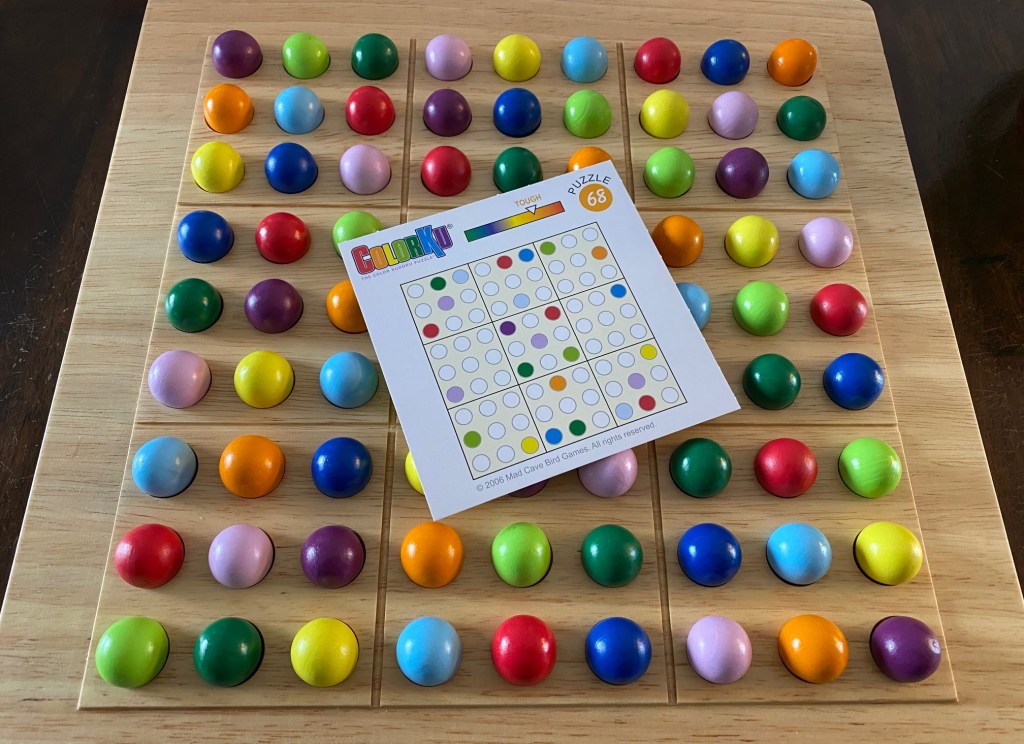
Colorku puzzle cards are ranked from easy to extreme. Unlike, say, mincing a turnip, where a novice would be severely punished by attempting to rapidly slice and dice the turnip like a pro (who said you can’t get blood from a turnip?), a novice Colorku player can attempt any level of puzzle difficulty safely.
It’s important to note that once a person has a basic understanding of the rules of the game, she can sit down at the Colorku board and play whenever and however she wants. The experience is self-driven and self-fulfilling.
Similarly, once a dog has an imprint on the target odor and understands that a reward will be exchanged for communicating the location of source odor, the dog can play the scent work game in a self-driven and self-fulfilling manner; merely using the human for reward delivery, not for guidance. Scent work is a puzzle game for your dog, not for you.
If you have trouble seeing scent work as your dog’s game, just contrast it with obedience and agility. Virtually no dog could enter an obedience ring and just perform a whole routine from start to finish because he felt like it. Obedience is not the dog’s game. It is the human’s game and the dog is taking cues from the human. Same for agility. Some dogs might enjoy a free-for-all racing through tunnels and over A-frames, but no dog is going to go to an agility course without a human and run it correctly from start to finish – it’s not the dog’s game.
If a dog invites the human to take a more meaningful role in the searching game, it is because the human has demonstrated a genuine effort to learn the dog’s language and communication style – not because the dog needs the human, but because the dog enjoys partnering with the human (there are some humans who are needy and want the dog to be needy, some dogs will adopt needy behaviors).
Skilljoy or Killjoy?
Along with life, liberty and the pursuit of happiness, I’m pretty sure it’s a self-evident truth that skill and joy have an inverse relationship at the extremes. It’s no fun to have zero skill, and it can be downright soul-crushing to have world-class skill. Just think of how many top athletes retire from their sport of choice and then choose to play it just for fun – not many, if any at all. Playing with a high level of skill brings the highest level of expectation, and expectation tends to squash joy.
Do an honest assessment of how you would approach a game like Colorku. Odds are, you’d want to enjoy yourself – have fun. Maybe you’d get a basic understanding of the rules and the desired outcome through watching someone else play, or by reading the instructions. Then, you’d start playing and start learning from your experiences, like on-the-job training.
It’s possible you’d take a more structured approach to learning Colorku; spending all of your time breaking down the strategies involved in solving Colorku puzzles, then practicing those strategies in contrived settings, making sure to focus on step-by step, linear skill-building (from easy to extreme), and consistent, perfect execution of those skills.
Counterintuitively, high level skill often arises from a more organic, self-driven learning experience. Josh Waitzkin found his way to a highly effective style of chess by playing – just for fun – in Washington Square Park with a variety of players. Bill Bradley became an amazing basketball player by spending all of his free time alone, just him, a basketball and a hoop. Serena Williams developed her love of tennis at a young age, playing with her parents and siblings. Each of these amazingly skilled people eventually sought out high performance coaches to round out their already world-class skills, not to engineer them from the start.
If you do choose the exacting process of deliberate practice and step-by-step/easy-to-hard learning to build expert level skills in Colorku, you’ll likely end up having traded joy for expectations. Your skills will have a “cost” that must be paid back through performance, or you’ll feel enormously let down.
Holmesing In On Colorku Skills
The most effective skills for Colorku are deductive reasoning skills, the kind Sherlock often schooled dear Watson in. Colorku has clearly defined rules: no row, column or square can have two balls of the same color. These rules allow a player to confidently place a ball if he can see multiple moves ahead – however, this can be really difficult when the board is mostly empty.
Enter Colorku strategies. These are basically Sudoku strategies and they have fancy names like X-wing and Swordfish. You may be employing some of these strategies without even knowing it, but you may also be completely unaware of some ways of looking at the board. Most Colorku strategies focus on eliminating possible placements of a ball in a row or column as a way of arriving at the correct placement of that ball. If you’re interested in descriptions of these strategies, check out this site: best of sudoku.
Inductively Reasoned Into The Scent Work Hall Of Fame
Scent work puzzles involve both deductive and inductive reasoning. When a dog has scent from source, figuring out its location is a deductive reasoning challenge. When a dog has indirect odor collecting throughout a search environment, or when a dog has a very large, blank search area – or when a dog is dealing with confusing communication from the handler – inductive reasoning has to be employed.
If a dog appears to be deep in deductive reasoning to solve a problem to source, but progress is halting, it’s very often a physical access issue. Many dogs don’t like to climb all over aluminum bleachers. Many dogs don’t like to touch unstable objects, like swings at a playground. Some dogs don’t like shiny floors. These inhibitions will cause a dog to range out, hang at the fringe of odor, and take more time to either commit to the necessary physical action or to figure out a different way to communicate the location of source. You can certainly help your dog with positive exposure to climbing, crawling, traversing, and balancing on a variety of surfaces and objects separate from scent work practice.
If a dog is using inductive reasoning (taking in data to discern a pattern), he might do very well when he only needs to make one or two leaps of logic from indirect odor data to locating source. What if the odor data the dog is collecting has far too many possible conclusions? There may be strategies that can help. Some of these strategies develop naturally in some dogs, like the decision to move with the wind/prevailing airflow until clearer odor info presents itself, or the use of triangulation. Some strategies can be prompted by a human through pattern training, like changing pace and/or direction, or working corners, objects and various planes of space systematically, independent of odor.
Do not be fooled by the allure of training a dog to be “better, faster, more reliable” using strategies. Humans love to have control over everything, but teaching a dog how best to search for and solve odor puzzles can backfire. Some strategies that make sense to us humans, only make sense visually and spatially, but don’t actually solve the problem of a dog’s need for more and better data to discern a pattern and solve an odor puzzle. There’s a good chance that we humans are completely blind to a number of viable strategies our dogs would like to develop, so it might not be the dogs who need to learn something new!
If you search blind – without trying to mimic competition search parameters – and pay attention to your dog’s behavior, you will learn a whole lot about your dog’s search style, preferred strategies, and potential areas for improvement.
The Good Pain of Puzzle Purgatory
Some Colorku puzzles require the player to tap into a deep reservoir of resolve, trading confidence for uncertainty and skill for inefficiency. For the outside observer, this is a painful scene, like watching a slug squeegee itself across someone’s face like a tiny brown glacier. It screams out for intervention, rescuing. For the resolute player of the game, it’s a highly exciting experience existing outside of time. Calculations are whizzing through your mind, possible moves arise and disappear before your eyes as you weigh the exhilarating prospect of action with the dread of unseen error growing like a rotten seedling, only to pop up late in the game and poison the whole board. It’s pure blissful torture.

Among humans, a Colorku player deep into a challenge may elicit concerns from onlookers, vocalized as such: “Do you want any help?” “Is it maybe too hard? You can start over.” “Do you want to just look at the answer key?” “Ooooh! I see a move! Lemme show you!”… Guess what? The Colorku player wants to hear none of it! He just wants to savor the intensely satisfying experience of fully embracing the challenge.
The dog who is deep into a challenging search, full of resolve and loving every moment of it, is sometimes hard to understand from the outside. He might slow down or stop. He might swing from energetic behavior changes to sloth-like sleuthing. He might go in circles like a broken Roomba, or stop and stare into the ether like he’s lost his marbles. These are all outside appearances that don’t necessarily reflect the dog’s inner experience.
Even humans can’t always accurately guess at each other’s inner states when facing a challenge, but, we don’t have to. I can clearly tell someone that all is well, I’m happy on the inside, leave me to enjoy my suffering. A dog working a complex scent puzzle and savoring the challenge can be more cryptic (from a human’s POV) when relaying his inner state of being, sometimes repeating a particular pattern of behaviors to show he’s acting with purpose. A handler can project his own confusion, frustration, or fatigue onto the dog – which can derail a dog’s efforts. This makes it crucial that humans learn to understand the difference between a dog soaring in problem-solving bliss and one sore with problem-solving blisters. One of the only ways to know this is to allow your dog to show you patterns of behavior that deepen your understanding of what he is experiencing.
You Have All The Answers… If You Want Them…
Colorku comes with an answer key that shows the solution to every card; your belief about the purpose of the answer key is culturally important, leading to styles of gameplay that are as different as onions and Funyuns. You might believe the answer key isn’t necessary, and decide to toss it in the trash before you play (you probably don’t believe in using the directions to Ikea furniture, either), or you might laminate the answer key to preserve it for all time!
If you decide to keep the answer key and use it in your puzzle-solving process, what’s the big whoop? There’s actually a fundamental big whoop. Having an answer key tempts you to look for the correct move anytime you feel like it, and it prompts you to safeguard your perceived progress – confirming your moves are correct as you go along. Even if you plan only to use the key for your first few games, you risk embedding habits in your subconscious that will mislabel challenging experiences as painful experiences, and your brain will do everything possible to avoid future “pain”.
If you keep the answer key, use it carefully and plan to wean yourself off of it as quickly as possible. There is no substitute for the learning you get from starting games over and paying careful attention to the moves you make.
An answer key exists in scent work just like in Colorku. Anyone who knows where the hides are has the answer key. Anyone who relies on a third-party observer (coach or judge) to confirm their alert & finish calls – hinging their future actions on this confirmation – has the answer key.
Before you decide to use your scent work “answer key”, ask yourself if it is your dog who is tortured and needing help, or if it is you. Do not fool yourself when observing your dog exhibiting unusual or hard to understand behaviors, or when progress is not clearly being made – if your dog enjoys a long, labyrinthine puzzle, all is well. In times of challenge, the inner state of your dog will not always match the outer behavior. The most helpful thing you can do is be present with your dog, experiencing the challenge with him.
Lest you think you can go on auto-pilot and just watch your dog descend into problem-solving darkness, assuming his inner state is all sunshine and rainbows, you need to build clues as to when your dog has had enough of a challenging search, and needs a break or needs to be done altogether. If you don’t build your observational skill, you’ll end up tailoring your dog’s search experiences to avoid challenge, and deprive your team of crucial skill and relationship-building opportunities.
Endgame
Colorku has a finite number of possible arrangements of the colored balls. A computer (or a highly dedicated person) could learn all possible arrangements and solve all possible puzzles. The nature of scent work is that the mix of variables present in any given search environment cannot be easily (nor completely) catalogued using pattern recognition. Your dog likely enjoys solving any scent work puzzle, even the puzzles that are completely novel and quite challenging. Yet, this open-ended gameplay means that, no matter the skills you acquire, you and your dog will occasionally run into completely perplexing scent puzzles that require the utmost focus, resolve, and risk-taking one can imagine.
If the idea of aiming at a mastery target that randomly shrinks and retreats into the distance sounds less than glorious to you, what you may be looking for is Colorku style scent work: scent work searches with limits on the puzzle combinations and outcomes. This is what scent work or nose work sport organizations offer at present. You get a “game card” with part of the puzzle filled in – hide count, search area boundaries, rules limiting where and how hides can be placed, expected patterns of those setting hides, etc. – and you trade the challenge of facing up to the limits of your current skills for the challenge of finding all the hides and racing against the clock. There’s potential harm in playing this way: perfection and speed become prized over skill. Sure, it takes some skill to be fast and accurate, but, there is rarely an opportunity to truly solve a complex odor puzzle under these constraints.
Be One With Your Dog
Play Colorku twice – once with an easy card and once with an extreme card. Note your experience: did you struggle to find the solution or was it easy breezy? If you breezed through the puzzle, was that fulfilling or were you left wishing you’d have been more challenged by the puzzle? If you got hung up by the puzzle, were you enjoying the challenge or was it too much? Even highly developed deductive reasoning and pattern recognition skills don’t guarantee a person to be a genius Colorku player, the same way highly trained scent work teams aren’t guaranteed to succeed in a competitive search challenge. If informally playing with Colorku from easy to extreme is potentially helpful before you work on developing certain skills, playing with a variety of scent work search challenges from easy to extreme might be helpful in allowing your dog to guide you through his idea of a joyful scent work skill-building experience.
Play Colorku alone and note what it’s like to search your own knowledge bank and pick your own plan of action each step of the way. Then, play it with a friend who is like-minded when it comes to puzzles. You will probably find that you enjoy both versions of gameplay, but maybe you like one a bit more than the other. Your dog has preferences, too! While we often say an “independent” dog is the best kind of dog for scent work, we really mean a dog who will do everything for us. Independence is a character trait, not an agreement to work alone. Make sure you understand how much your dog enjoys solving scent work puzzles solo and how much he enjoys conquering odor cones with a compatriot.
Whatever your dog’s puzzle-solving preference (generally, and search-specific), try to join him as a silent supporter or a like-minded leftenant. You want to be the teacher/partner/friend that enhances your dog’s search experiences. Be the Goose to his Maverick, the Thelma to his Louise, the – pick two characters that both get to live! Never forget that this is your dog’s game, and not a job you get to boss him around at like a treat pouch wearing Bill Lumbergh (look it up if you gotta).
Play Colorku to get yourself in the puzzle-solver’s mindset, then go search with your dog and really connect with him, one puzzle solver to another. I promise, you’ll have a much deeper respect for what your dog loves to do.
Get Colorku Here – support the blog!
Happy Sniffing!
 Sniff This Blog
Leave a comment