
Ed Yong recently wrote a book titled, An Immense World, about the difficulties inherent in trying to imagine what it’s like to be an animal other than a human (spoiler alert: we suuuuuck at accepting the validity of other animals’ experiences). At the heart of the book is the concept of Umwelt, or self-centered world. An octopus (which has a brain in each of its arms) has an Umwelt different from a little brown bat (which uses echolocation to hunt prey). Umwelt courses through the book, animating the many stories, interviews and pontifications on animals and their unique sensory experiences. Ultimately, Ed concludes that if we continue to improve the tools of field biology, and remain open to the alien sensory experiences of other animals, we may come to know just what it is like to experience the world as a naked mole rat, a dolphin, or an orb-weaving spider.
That all sounds super awesome, but I just want to ask the question: what is it like to be a scent work team? Do dog and human – each an animal with a distinct Umwelt – merge their experiences together into a new Umwelt when they search together? Do we end up with a dohumag, or a domo capiens from an experiential point of view?! I’d like to think it’s possible, but mostly it appears that we humans – to paraphrase Ed – prefer to stay firmly put in our own house, looking out the window at our own garden, impatiently waiting for our dogs to inexplicably see things our way while they do their thing: solve scent-based puzzles.
Before we even try to leave our sensory “house” and experience scent work as a synesthetic game of hide and seek, let’s just focus in on what it is like to be a human playing a distinctly human game. In my experience, scent work is least like golf, or target shooting – games with near perfect information, and pre-rehearsed actions that are adjustable to the conditions. It’s not much like chess – every move is potentially trackable backwards and forwards in time, and perfect play is possible. Scent work is a lot more like tennis or poker. In tennis you must constantly adjust your play to gain an upper hand on your opponent, yet you may not always know what your opponent will do next. This gap in knowledge is present in poker, too. You sit at a poker table with imperfect information. Some of your decisions are guided by probabilities (choosing to fold based on the cards in your hand and the cards showing on the table), and some are guided by a mix of experience and intuition (choosing to raise a bet based on another player’s behavior that may or may not correlate to the truth of that player’s hand). Both tennis and poker have enough variability in gameplay to prevent you from coasting through a game on autopilot, and both games involve a fair amount of luck by way of how each player handles the complete unknowns.
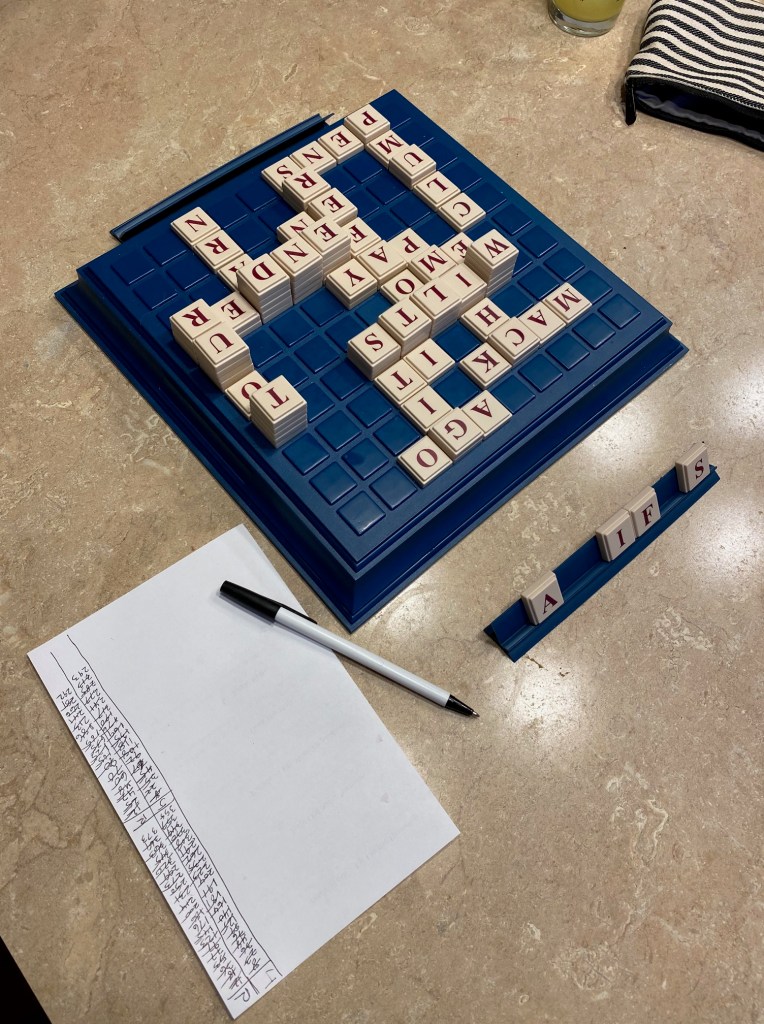
Instead of gambling and scrambling to enhance our understanding of the scent work experience, lets go for a word puzzle game: UpWords. A ridiculously fun variant on the game of scrabble, UpWords grants each player 7 tiles per turn with which to form a word on the board left to right or top to bottom. Unlike scrabble, a player can stack tiles up to 5 high to create new words. This added dimension – much like the added challenge of a range or unknown number of hides – changes everything.
When you play UpWords, try your best to note the experience you have and see how aware you are of a) the sharpness of your mind (are you bursting with ideas or do you feel put on the spot, are you coming up with fewer words than you actually know); b) the quality of your focus (are you honed in on your opponent’s play just as intensely as your own, are you doing anything other than playing the game, are you checking your phone); c) the state of your emotions (overly excited or overly frustrated, competitive, taking things personally, disengaged, uninspired); d) your level of enjoyment (do you find the game to be fun or boring)
Also try to raise awareness to your decision-making, process-based experience by noting: a) the number of distinct problems you face each turn; b) the number of options available to you to solve each problem; c) the confidence level you have in each option you’ve chosen to solve each problem; d) the number of times you benefit from luck in a game
I’ve covered it in a separate post, but if you haven’t read Annie Duke’s book on decision making, Thinking In Bets, you might want to click the link and read the book asap. If you can’t imagine tracking your decisions while playing a game like UpWords, just imagine you and your dog as a pair of dice, rolling across the start line of a search, because that’s what you’re doing when you go to trials.
Starting A Game
You start a game of UpWords with each player picking one tile from the bag. The player with the tile closest to the start of the alphabet goes first, picking 7 tiles from the bag at random. The beginning of the game is all chance. You hope to go second, and you hope to get tiles that you can turn into lots of points for you and lots of headaches for your opponent.
When is your scent work team in a situation like the start of a game of UpWords? Well, your dog is certainly randomly advantaged as the two of you leave your vehicle and proceed to the search area. Sometimes there are few or no staging areas and the odor is available walking up to the start line, sometimes it takes eons to begin the search and a multitude of distractions chip away at the dog’s readiness. Try to remember that being randomly advantaged means it’s in your best interest to stay calm about the way things start off – some scent work handlers become easily distressed if they can’t get immediate and definitive proof that the search is starting perfectly.
In UpWords, when I draw closest to ‘A’ and must make the first play, I think first about getting rid of the highest risk tiles on my tray (Z,J,V,K,C,Y, Qu), second I think of limiting the upside for my opponent, third I think of leaving myself with the greatest number of options for my next turn. Ancillary to this process is making plays for maximum points. It’s rare that I can get everything I want in a turn, and highly likely my opponent will squash my plans the moment she sees what I’m building. This means every turn is a potential game-winning opportunity, especially the first one.
What is the dog’s experience of the “first play” in a search? A motivated, confident, reliable scent work dog will often search in a preparatory manner if given the freedom. This is the dog who checks the bottom seam of each door in a hotel hallway as you walk to your room. This is the dog who glides along the bumpers of parked cars in the parking garage, dipping between the cars just deep enough to put his nose beyond each rear wheel well. This searching dog seems to have a process that prioritizes odor connected to a source (a bracket, a concentrated tendril, or an edge) – however near or far – over indirect odor (pooling, collecting, convecting), then he engages with indirect odor, then he checks objects and surfaces for the possibility of odor. Each of these options the dog considers may have consequences later in the search.
A handler, who can’t or won’t experience – with the dog – the dog’s way of problem-solving, will screw up the dog’s way of problem-solving! Handlers who are uncomfortable with a dog blasting by the threshold, or impatient when a dog takes some time to investigate odor collecting in a window well, will either worry over the dog’s choices or proactively alter the dog’s choices.
Put yourself in front of the UpWords board again. How in the hell could you hope to win games if, from the start, a voice in your head doubted, reversed, or generally undermined your process and your decisions?! Don’t be that voice in your dog’s head. What’s that you say? You can’t trust your dog to make game-winning decisions. Well, it can’t be very fun for your dog to search with you, so figure out a way to prove to yourself that your dog is trustworthy, and be a voice that adds value.
Reacting To Your Opponent’s Play
Back to our hypothetical game of UpWords. I drew the first play, picked seven tiles, thought through my options and decided on a 3 letter word: HAY. It can’t be pluralized, it can’t be easily added onto to form two new words, and it can’t be stacked for lots of points (rule is that at least one letter from the current word must remain unchanged when stacking to form a new word). I’ve gotten rid of a ‘Y’ and my current set of tiles gives me options on my next turn… My opponent plays and lays all 7 tiles to form AVERTED, changing HAY into RAY. That’s a 20 point bonus on top of the two word score. This is one of the worst possible starts to a game for me.
I’m reeling. The unexpected has just happened (it’s exceedingly rare to make a 7 tile word in this game). I’m faced with a decision: stick to my process and get rid of the ‘X’ I have, or attempt to maximize points and score an emotional victory? There is no easy answer here. An ‘X’ could sink me late in the game, but that might not matter if the point gap widens too much. I don’t know what my opponent pulled for tiles, for all I know, she has 3 ‘E’s, two ‘U’s a ‘J’ and a ‘Z’.
Who is your team’s opponent in a scent work search? Well, it could be the person who sets the search (but, probably not, as most of these folks are making predictable choices in your favor – think chairs and trash cans). It could be the environment. It could be both the dog and the handler, opposing each other.
Environment becomes an opponent simply because it is unpredictable. Shifting wind, a patch of sunlight shining in through a window, or a herd of curious horses hanging out on your search boundary. Just as you can pull poor tiles randomly from the bag, you can pull poor environmental conditions randomly.
Environment can also be an opponent because it contains high amounts of “noise” (distraction) to “signal” (odor). A dog’s work in a distracting environment can suffer, even without the dog being “distracted”. It will take me a lot longer to make a play on an UpWords board that is full of 5-stack tiles (the max you can stack) and killer crosses (words that adjoin such that there is no change you can make that would turn both into new words), but I am by no means in a diminished state of effort. A dog who must track odor collecting amongst the shrubbery adjacent to a highly trafficked walking path might be slow, careful and appear challenged, but his will may be as strong as ever.
Your dog may create opposition for the team simply by missing decision opportunities or by making poor decisions. Yes, dogs can make poor decisions – hooray, we’re not alone!
You may be an opponent to your scent work team. When you are unpredictable and distracting, you force your dog to react and make decisions that may be driven by what he thinks you want. If you are not aware that you are derailing your dog’s efforts, you might interpret his behavior with confidence, causing you to call alert in an area with no odor, or causing you to repeatedly pull your dog away from an area with odor. Things like that.
Why do handlers turn into opponents against their team? For the same reason I panic and go for points, giving my opponent a way out of a tray of bad tiles. For the same reason a dog hitches his nose to fickle forms of odor info, getting lost in a ghost chase. We react, we make a decision, and we face a consequence. Just exactly what it’s like to face a consequence when you’re a dog doing scent work is the question. I know what it’s like as a human playing UpWords. You make your decision, your turn is over, and then you see, clearly, what you’ve done and what you could have done. But, something else can happen. Your opponent can make a move which makes your – up to this point, regrettable – decision positive beyond what you thought possible.
A handler might think he sees the folly of his dog’s decision to engage with complexity, or to search amongst distraction, and he might think he can do something to avert crisis and refocus the team’s efforts on something more productive. What about those times where, just as the handler is about to intervene, the dog shifts into a recognizable set of behaviors and solves the puzzle – how can a handler know when to stay the course? There is no easy answer.
Getting The Feel Of The Game
Within the first few turns of play, I and my opponent can get a sense of the kind of game we’re in for – be it a high scoring shootout, or an agonizing one-tile-per-turn limp to the finish line. Sometimes, one of us will get all the right tiles to capitalize on stacked double words while the other watches in horror. Wether I’m flying high on high scoring turns or down low in the gutters making garbage plays for garbage points, the feelings I experience are not me. Meaning, my fortunes could reverse at any time, either through stellar gameplay or by luck. Learning to be with the feel of the game, but in a detached way is the only way to advance your skills towards consistent high performance.
Checking back in with our scent work dog, it’s very likely he experiences getting the feel of a search. Some searches bring out a wild energy in some dogs, other searches submerge the dog in invisible molasses. If you can believe that the dog is plugging into the vibe of the search, then you can also believe that no single search performance is “your dog”. Some searches are like cruising on a cotton candy cloud, and some are like drowning in the devil’s explosive diarrhea.
As a handler, you can learn to experience the feel of the search through your dog. Focus on your dog’s behaviors as if your eyes were fingertips and you could feel everything you’re seeing. Note how your body responds when you let your eyes feel the dog’s behaviors. You should be more intuitive in your movements and responses to the dog. You should be getting closer to the same feel of the search as your dog.
If you can groove in the search with your dog, you can enter the space where you stretch and grow your skills. I’ve witnessed a few searches where the handler and the dog are one mind, and it is spectacular. I do think it is absolutely imperative that you do not force your dog to compromise his style of play if you want to have a shot at experiencing a unification of purpose. If you’ve ever played a puzzle game with someone hanging over your shoulder offering unbidden advice, you know it can be a symbiotic problem-solving force-multiplier if that person gets the way you’re playing, or a parasitic brain drain if they don’t. Be the force multiplier, not the parasite!
Playing Through The Middle
As with most experiences on this planet, the beginning and end are the stars of the show, and the middle, well, it kinda distracts you with a lot of failed efforts to resolve the inciting incident, raising the stakes ever higher so the payoff at the climax is greater than expected.
The middle of our UpWords game most certainly serves the same purpose. Both players hope for the opportunity to establish a commanding lead, but even a 40 point lead can be erased on the final play (remaining tiles count as -5 points), so we battle it out until we are close enough to the end to strategically strand the other player with lots of tiles.
Complex scent work searches have the same story structure. I recently worked with a team who was searching for 5 hides in a CrossFit gym (thanks Vanessa!), 4 of the hides were clustered in one corner and the remaining hide was above the door that served as the threshold to the search area. The middle of the search began after the last of the close hides was found. For a lengthy amount of time, the dog battled with indirect odor, working three separate areas in noticeably different ways: softly searching stacks of weights with odor falling onto them, tracing the seams of the foam floor tiles near a heating unit mounted high on the same wall as the hide, and twisting and twirling in open space between the door with the hide and several nearby exercise bikes. He appeared to be failing to find the clear line to source that he was hoping for, and his handler was losing resolve. After much effort and stakes that couldn’t get much higher, the dog intensified his behaviors in the area around the threshold, moving back and forth through the open doorway. He found a bracket between a wall corner to the right of the door and an open bathroom to the left. Within that bracket he worked low to high up and over a sink, a mop bucket and a water cooler. Ultimately, he narrowed the area down to a length of wall between the door and the water cooler, and repeatedly air-scented, orienting his nose to the location of the source. His final communication was to stand 5ft from the wall and gesture to the hide with his eyes. His handler trusted him enough to know he’d narrowed his area and made a decision. What an ending!
A great game of UpWords, a great search, it’s gotta have a middle to have an exciting ending. With UpWords, you know you always have a middle of some considerable length. With a scent work search, it could last 4 seconds or 18 minutes. Very fast searches with hides that produce just a single behavior change into source can be fun, too. Balance and variety should be established to benefit each individual team.
Victory
As we near the end of our UpWords game (depleting all tiles from the bag), I am looking to go out first. Our scores are on the low side: 225 to 237, I’m behind. If I can stick my opponent with just 3 tiles, I win outright. If I can’t, I’m going to need a 30 point play and to get down to just one tile left. There are many paths to victory in UpWords. The game depends a lot on the luck of what tiles you draw, but it also depends on skills you can wield to greater effect than the other player. The more words you know, the more possibilities you see for points. If your opponent knows far fewer words than you, she may stare at potential plays and pass them by like a stranded hiker in the wilderness, huddled and hungry with edible plants hiding right beneath her boots. The better you are at counting tiles, the better your chances of going out first. The easier it is for you to see patterns forming, the more control you have in limiting your opponent’s play, or forcing your opponent to play to your favor. “I have no choice” is a phrase often spoken when your opponent has left you with very limited options. The player who manages to see choices where none seem to exist is the player most likely to win.
In scent work, winning is not as clear as it is in UpWords. You can win competitively and place at the top in a search or a trial, but it’s possible to do so with utterly dreadful teamwork. You can win personally by meeting your goals. You can also win by accumulating consistently exceptional performances. Maybe it’s better to be victorious than to win. If you can excel at fully supporting your dog in his chosen style of gameplay, such that the two of you can transcend the challenges cast upon you by your opponents in odor (hide setter, environment, each other), then you will be victorious in searching.
Reflections
The final play of our UpWords game sees me stuck with one tile as my opponent goes out on a play of 6 points. Our final score 255 to 245 (240 after the -5). Some days, I will let my emotions get the better of me and just scrape the tiles off the board and back into the bag to start another game. If I’m in a better headspace, I’ll look over the board and think through what I could have done differently. My opponent (my wife) is formidable. Most times that she wins, I simply did not play as well as her. Even when I’ve had bad luck with tiles, I can still point to decisions I made that could have changed the game in my favor. Generally, I don’t alter my core strategy, I just look for ways to execute it more successfully.
Over many games (hundreds) my wife and I trade off with a record slightly above .500. The best high stakes poker players have about the same winning percentage. With all the randomness involved in selecting tiles, this is a pretty accurate measure of our performances.
When you’ve called finish and your search is over, the time is right to reflect on how it went. Did you provide your dog with every opportunity to be his best from start to finish? Were you able to see your dog’s communication through his behavior changes, or did you miss some key moments? Did you simply get outplayed by your opponents (including beating yourselves)? Did you have to battle with bad luck (or did you get the benefits of good luck)? Are you and your dog eager to search again, or are you (and/or he) needing to recharge? Do you see a need to overhaul your core strategy? What can you do to execute your role more successfully next time?
What is an accurate winning percentage for a scent work team? I don’t know. At the Elite level, you can find 80-90% of the hides in most trials and never have to solve a complex odor puzzle. I guess an UpWords player can win a game and never play a word beyond a first grade vocabulary – but that’s unlikely to be repeatable. I think it would make more sense if a scent work competition drifted a little closer towards poker on winning percentages. Imagine an Elite trial where 50% of the searches are complex and the best player scores 70 (a few of those exist). That kind of trial has storytelling potential – opportunity for an exciting finish. That kind of trial offers a chance at being victorious in partnership with your dog. If a team can consistently score 70 points in that kind of trial, I’d call it an accurate measure of a team performing at the pinnacle of partnership.
I’d love to give you a link to purchase UpWords and support the blog, but Amazon is outta control on pricing! Go find UpWords at Target or your local GoodWill. If you’d still like to support the blog, you can go to the donate page and make a one-time or recurring donation.
Happy Sniffing!
 Sniff This Blog
Leave a comment