
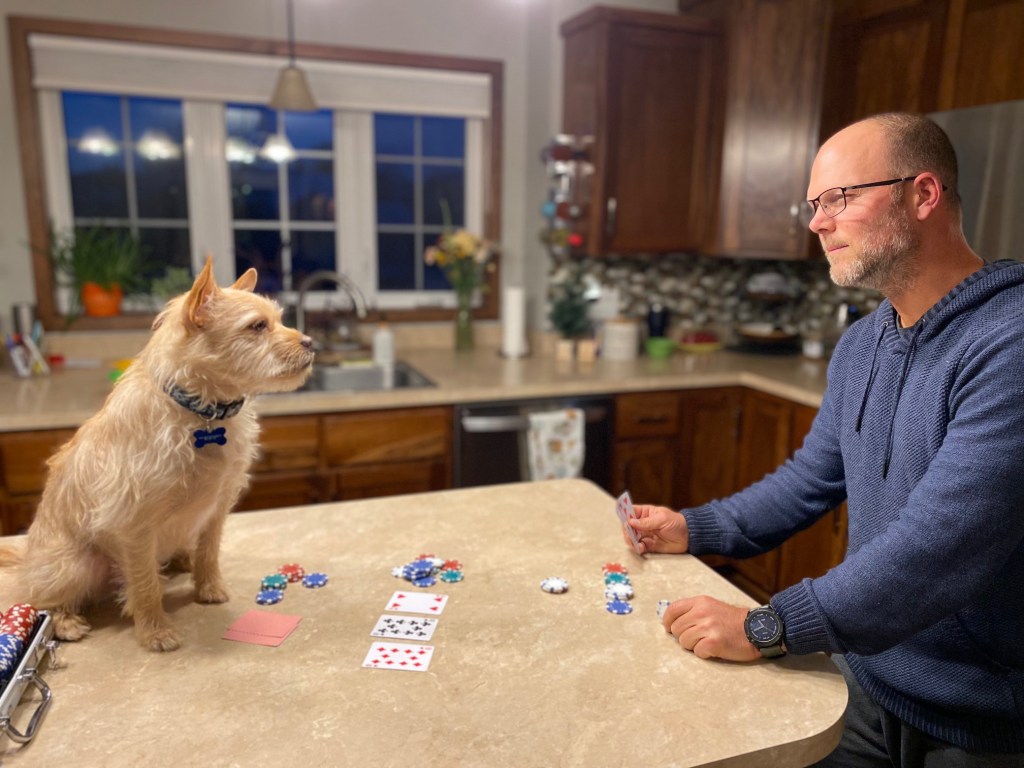
In many ways, we could call scent work, Texas Sniff’em. Much like poker, scent work is a game of imperfect information, and decision making under uncertainty. The official creating the search has given you some amount of information about the search – in some cases, information that can be deceptive, like 5 minutes to search an area you don’t know is blank – and you must read your dog to gain important, but sometimes murky, clues about the presence of odor and the location of source. While your dog is not your opponent (like players at a poker table), you sometimes enter into opposition with your dog due to the unknowns of the search and decisions you make (or don’t make) along the way. Also like poker, you can be the benefactor – or the victim – of luck. It is luck that makes poker and scent work so exhilarating at times, and so flummoxing and frustrating at other times. Only those of us who can separate our process and our luck from our outcomes can cautiously celebrate in times of good fortune, and carefully contemplate in times of rotten results, keeping our cool and mining all of our experiences for personal improvement. The rest of us are doomed to pull on the slot machine handle of scent work, hoping for “yes” calls to rain down on us like the cold hard cash of a jackpot payout.

All Players Are Welcome
Let me just put this out there: A CO or judge or whoever sets up searches and places hides should be free to create any kind of search that falls within the general guidelines of whichever venue you’re competing in. No one would poo-poo a poker player who excels at bluffing and who understands probabilities better than others. Quite the opposite, that player would be heralded. No one should poo-poo a person who can create searches and set hides that require high quality decision-making on the part of both dog & handler. Period. In fact, the person who can set a search that no team can solve should be the person we all take an interest in. How could that poker player beat every single competitor?! In all the searches I’ve watched over the years, bad luck rains on everyone’s parade once in a while, but bad decisions are more often the source of our less than stellar performances.
Annie Duke’s book, “Thinking In Bets” lays out decision-making in simple terms, using poker as an environment where direct connections can be made between our decision-making skills and our outcomes. Duke highlights the benefits of focusing on probabilistic thinking and level-headed evaluation of outcomes, and she has a number of helpful tools for ensuring that your process is sound and improvable.
Money On The Line
When Annie Duke’s brother (a world class poker player) suggested she find a legal game of poker near her home in Billings, Montana as a way to make some much needed cash, her love affair with the game began. Duke used her time at the Crystal Lounge to build a process for winning. She put money on the line, played a hand of poker and won or lost. She then assessed the many decisions she made or didn’t make in the course of that hand and carefully separated luck from learning.
Annie Duke became great at poker because she had to – it was not her hobby, it was her planned income source. While she might have learned the basics of poker outside of the competitive realm, she did not hone her skills at home playing against her children, using ritz crackers as chips. She found an environment – a real world poker game – where she could not hide from the consequences of her decisions, where her improvement or lack thereof could be measured by her winnings.
Learning scent work with money on the line is called: blind searching. If you do not think your dog is trustworthy or persistent enough for you to build your skills blind, go ahead and make that your top priority. Tap into your dog’s confidence and build his persistence, then sit back down at the table and place your bet. It might be hard at first, but you will find yourself with lots of feedback to learn from, and lots of wins and losses to tally.
If you’re brave enough, try paying your dog without first getting confirmation from a third party (traditionally, a handler calls alert, and a judge or coach says ‘yes’ or ‘no’). Even the simplest of blind hides can fill a handler with dread when no one is there to protect him from his potentially poor decisions.
If you’re scared to death of scent work as poker, take a deep breath and relax. It’s not that hard to get a read on your dog’s behavior at source and to become very confident in the quality of your decision-making. The hard part is to accept that even the best decisions sometimes result in the worst outcomes.
Resulting Feels Good, But Ages Poorly
“Uncertainty can work a lot of mischief” – Annie Duke
Resulting is a poker player’s word for the human tendency to equate the quality of a decision with the quality of its outcome. For example, if I choose to raise a bet and bluff other players into folding, I win the hand. My decision to bet and bluff may have been poor quality, even though my winnings fit the desired outcome.
If I decide to point my dog to a box he didn’t physically check, and he indicates and I call it and get a ‘yes’, my outcome is good, but my decision quality may be poor.
Annie estimates that a poker player might make hundreds of decisions in mere hours spent at the table – she says just one hand of poker can contain 2-20 decisions. When a player wins or loses, is it the the result of one or more of their decisions, or is it luck? Annie wants you to think probabilistically. As she says, “for most of our decisions, there will be a lot of space between unequivocal “right” and “wrong”.
Resulting occurs as a reaction to outcomes. If you point your dog to a box and get a ‘yes’, you might determine it’s a good idea to point out boxes. In subsequent searches, you might be on the lookout for opportunities to point your dog to boxes. If we know to avoid resulting, we might conclude that pointing out boxes the dog has no interest in is a poor decision, exposing the handler to misreading the dog and calling a false alert.
Resulting uses outcomes to radically change the probabilities of a decision to 100% or 0%. If your dog blows by the threshold of a search area and you later find out there was a hide there, resulting would cause you to feel like the decision to blow by the threshold gives you 0% chance of finding a threshold hide. This is clearly not the reality. Still, you might now decide to hold your dog longer at all thresholds, or to compel your dog to search all thresholds before moving on. Now you are potentially forgoing better outcomes because it felt bad to miss a threshold hide.
Until you can detach yourself from the emotional value of your outcomes, and just see them as choices with probabilities of success, you’ll want to avoid trying to “learn” from your searching experiences.
Love Hurts, Losing Hurts Even More
“…Winning $100 at blackjack feels as good as losing $50 feels bad to us.” – Annie Duke
All high performance people (maybe not John McEnroe) will tell you that emotions must not cloud your decision-making. That’s because chasing the positive feelings of good outcomes is a crappy deal – it leaves you exposed to the 2x negative feelings of bad outcomes.
What if we just decide to try and eliminate loss from our experience? This is clearly the goal of many scent work competitors, as the first thing they report after a search is, “I got no ‘no’s'”. Annie reminds us that uncertainty is guaranteed when making decisions with incomplete information, and loss remains a real possibility. For the people who focus on ‘no’s’, it’s like a $100 loss to make a false call, compared to a $50 gain to make a correct call. Of course they don’t want to take a $100 emotional hit!
For those loss averse competitors, the pain of a ‘no’ is so intense, they will say, “I’d rather leave a hide behind than get a ‘no’.” When emotions are what you base your decisions on, you are no longer looking at the decisions themselves. Sometimes, the decision that led you to call a false alert is arguably the best choice to have made in that situation.
Another goal of loss averse competitors is to “get out fast”, or call finish as early as possible when they perceive the dog has found all of the hides in an area. This goal derives from the emotional sting of staying in a search long enough to make a bad alert call, or from the results of a trial, where you learn that you missed out on the ribbons because you didn’t call finish fast enough. As we’re learning, meeting this goal will never feel as good as missing it feels bad. It is not a healthy deal to make with yourself. The decision to call finish in any search is highly dependent on the information at hand, not on the feelings you wish to avoid.
Wanna Bet?
“In Most of our decisions, we are not betting against another person. Rather, we are betting against all the future versions of ourselves that we are not choosing.” – Annie Duke
Annie wants us to see every decision in life as a “bet”. A bet is defined by Merriam-Webster’s as “a choice made by thinking about what will probably happen,” “to risk losing (something) when you try to do or achieve something” and to make decisions that are based on the belief that something will happen or is true.”
We are always weighing alternatives, assessing risk, and assigning value – it’s called living life! A main driver of our daily bets are our beliefs. If we have accurate beliefs about something (penguins don’t fly), we will make successful bets; if we don’t (rattlesnakes are cuddly), we’ll suffer a painful loss. In life, it’s not possible to have completely accurate beliefs about everything all of the time, so your goal is to get cozy with doubt and to vet your beliefs regularly.
Competitors (and many officials) used to say that container searches were the lowest pass rate element in NW3 trials. A quick check on the facts revealed interiors to be the lowest pass rate element (not surprising, since interiors consisted of 50% of a competitor’s searches). Inaccurate beliefs are pernicious creatures. Most people believe high hides are hard hides, but there’s no evidence of that, either. Any kind of hide can become elusive. We are hard-wired to believe what we hear or read without much consideration for the truth. Low fat diets were sold to Americans as healthy (the trade-off of carbs for fats was decidedly unhealthy), suited connectors (a 6 &7 of diamonds, for example) are widely believed to be low risk/high reward hands by most poker novices… but they’re not.
Be careful what you choose to believe. Be willing to alter your beliefs based on credible information. Practice betting rather than deciding – betting means you acknowledge the risk of losing up front, and factor it into your decisions.
When I CO’d lots of NW3 trials, I got into the habit of betting (not for money, just for fun) on the outcome of the trial and the individual searches. Before the start of the trial, I would share with the score room how many titles we’d have for the day and which search would be the lowest pass rate. It turned out I was very accurate with my bets. This was the result of tons of observation of competitors and lots of experience COing. My beliefs about the behavior of dogs and competitors, the movement of odor, and the effects of environmental conditions were highly accurate.
When I competed with my dog, I failed to think in the ways I thought as a CO. I did not check my beliefs for inaccuracies, I did not consider if Muriel had any inaccurate beliefs, I didn’t think in bets, factoring the risk of losing into my decision-making process. I had the belief that my dog was a hungry hide hippo, I hated losing, and I did not want to leave a hide behind. I made decisions while searching that were emotionally driven, loss aversion type decisions. Where was Annie Duke when I needed her?!
Point Your Finger At The Handler In The Mirror
It’s super important to have a process for decision-making that includes accurate beliefs, an understanding of the completeness of information, and a factoring in of the risk of loss – you want to make the best decisions you can make as a handler (which includes assessing the quality of the decisions your dog is making). Equally as important is the process you have for evaluating the feedback from your decisions: the outcomes of your efforts.
We talked about separating luck from skill, which is necessary for improving performance, but we haven’t talked about what to do with the skill-based information from your decision-making efforts. If you separate luck from skill, you’re left with good and bad decisions across a spectrum. Annie points out that sometimes you make the second-best decision possible, that doesn’t make it a bad decision. Similarly, sometimes all you have are decisions on the bad end of the spectrum, picking the best of the worst is a win.
In scent work, we have a dog making decisions, a handler observing these decisions, and a handler making decisions. If we observe a dog’s decisions and see opportunities for improvement, we should take action in training. This could be improving stickiness to source, increasing the dog’s expectation that thorough, continued searching efforts are likely to reveal the presence of odor, or reframing the dog’s relationship to indirect odor, such that he engages it as a sourcing option only if he cannot discover direct odor from source. It’s actually far easier for people to work on a dog’s skills than for people to work on their own skills, but there are plenty of scenarios whereby the dog’s decision-making is dependent on the quality of the person’s skills.
If we observe our own decisions and see opportunities for improvement, the training begins with our mindset. This could involve priming the mind to focus on the dog, it could involve creating habits that lead to consist communication with the dog, it could involve practicing decision-making in real time. The same way in which a poker player’s decisions evolve as more bets are placed and more cards are revealed, a handler must be prepared to consider her options and reassess them as time passes and the dog paints a more complete picture of the presence and absence of odor. A player that starts with two cards and a probability of winning at 80%, can find himself just five rounds later at a probability of 24%. Learning to read your dog probabilistically is the most challenging part of being a handler.
More than once, I have seen a dog display clear behavior indicating presence of odor and high probability of a nearby hide, but the dog does not advance towards a source-locating and indicating behavior. If you’re thinking in bets, there is an 80% chance a hide is nearby. As time goes on, you must decide what the dog’s continuing behaviors mean in relation to your initial bet, and you must decide if you are to play a role in the dog’s efforts. What you learn in the next 30 seconds is that your dog continues to confirm that odor is present, but still has made no progress. You now have different bets to make: do you believe your dog is near a hide vs caught in indirect odor, if you believe your dog is near a hide, what are the chances he will suddenly source it after such a lengthy period of repeated patterning? You’ve seen behaviors from your dog that give you 95% confidence he is near a hide. You feel only 20% certain that he will source the hide on his own if you just give him more time. Your last decision to make is: based on what you believe about your dog and his patterns of solving problems to source, what is likely preventing him from sourcing this hide? Is the hide too high or deep? Is there a physical move your dog needs to make that he is unable or unwilling to make? Can you add value in some way? You decide your dog is unwilling to climb on the netting of a baseball pitching blind which he has been bracketing, so you adjust your body posture and show your support in the area of the pitching blind and seconds later your dog is on his hind legs, gingerly touching his front paws to the netting, excitedly sourcing a hide on the tubular metal frame, just within his reach.
If you are the kind of handler who watches everything described here, does nothing, and watches your dog disengage and leave the area of the hide, you might benefit from examining your outcomes! While it’s true that not all hides need to be found, it’s also true that not all hides are found with 100% effort from the dog and 0% effort from the handler. There is a spectrum of collaboration.
CUDOS
If you’re hoping to be a better partner with your dog, but you are lacking motivation or clarity, Annie would suggest you form a group to help with evaluating outcomes and improving your decision-making process. Annie cites the founders of Heterodox Academy and the norms of their community:
Communism (data belong to the group)
Universalism (apply uniform standards to claims and evidence, regardless of where they came from)
Disinterestedness (vigilance against potential conflicts that can influence the groups evaluation)
Organized Skepticism (discussion among the group to encourage engagement and dissent)
I am comfortable fulfilling these roles in a group, but Annie points out that most people seek out groups that act as confirmation-bias machines, basically operating in the opposite way. So, it might be harder to create a group where all people agree to abide by the aforementioned norms. But, it’s well worth the effort.
Go All In With Thinking In Bets
Thinking In Bets is full of additional information not covered in this post. I highly recommend you read this book and support the blog. As a scent work coach, I observe both dog and handler making many decisions over the course of a 5 minute search, and I almost always see the handler undervalue the dog’s behaviors and communications. The same way in which a poker player must learn to read the behaviors of the other players as a way of gaining confidence in what cards they are holding, a handler must be able to increase his confidence in the odor “hand” the dog is holding. This happens by improving the accuracy of our beliefs, understanding the possible outcomes of our bets, thinking probabilistically, and repeating the process.
As Annie says in her book, “thinking in bets is hard, especially initially. It has to start as a deliberative process and will feel clunky, weird, and slow. Certainly, there will be times it doesn’t make sense.”
As you continue your journey through the casino of scent work, ask yourself: are you a poker player, marshaling your skills to dance with the devil of chance and gain the edge on your team’s search outcomes? Or are you a slot machine zombie, rattling your plastic cup beneath the coin tray, praying to the odor gods for a good search?!
Happy Sniffing!
 Sniff This Blog
Leave a comment