
“Do you remember, the 21st night of September?
Love was changing the mind of pretenders
While chasing the clouds away…
Ba-dee-ya, dancing in September…
This post could be about Earth, Wind & Fire – which would be groovy – but my mind is on actual earth, wind, water, temperature, sound, and scent work.
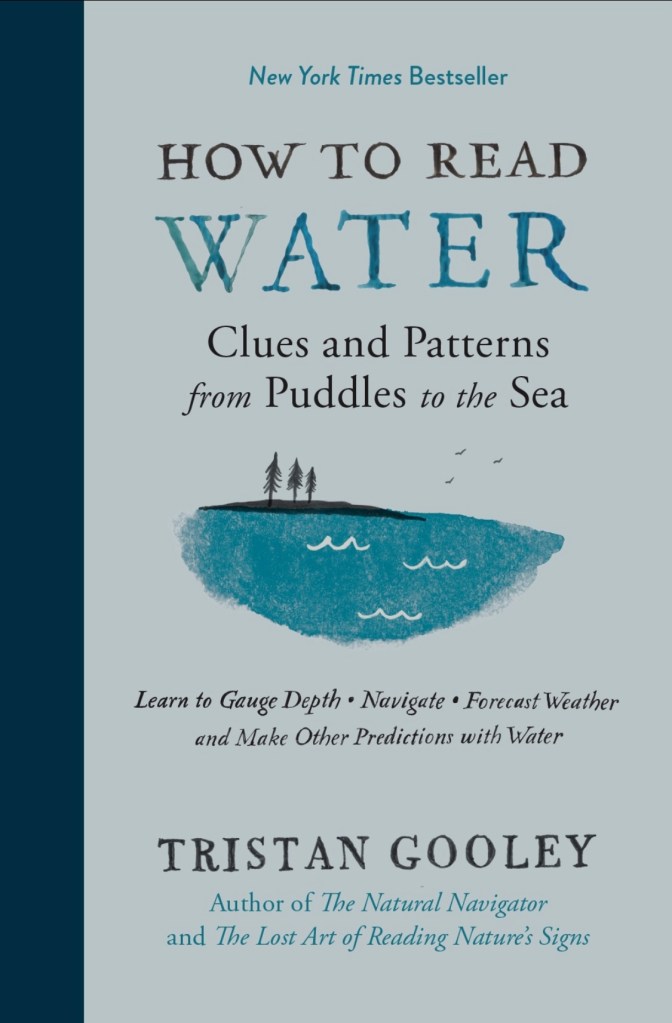
The soundtrack for this post comes from the book, How to Read Water: Clues and Patterns from Puddles to the Sea, by Tristan Gooley. The content of this book is akin to the effect of magic mushrooms on perception (full disclosure: I have not yet taken psychedelics): your mind will be altered, your senses will be enhanced, you will unlock the secrets of existence (I can’t guarantee that last bit unless you actually take shrooms, as I believe they’re called)! It’s been said that sufficiently advanced technology is indistinguishable from magic. The way dogs and odor interweave to produce the results of a search often feels magical to the observer, but dogs are old hardware (some research points to dogs living with humans as far back as 40,000 years). New tech or old, part of the magical aura of dogs working scent comes from a lack of understanding of where and how the scent is moving in the environment. Enter, our benevolent teacher, Mr. Gooley.
Go With the Flow
The movement of water and the movement of air can be described by principles of fluid dynamics, but, unless you have lofty aspirations of a PhD, terms like compressibility, viscosity, autophagosomes, self-propelled anguilliforms swimming in a quiescent flow or Karman gaiting in a Karman Vortex street, will only result in a phase change from human to mush-brain. In How to Read Water, the real world and its properties are your lexicon, the methods for enhancing your understanding of the movement of water, air, and sound are derived from centuries old techniques applied by people who had to adapt their senses and learn to read nature’s signs in order to survive. The most prized result of learning to read water is an overall increase in awareness to one’s environment. Imagine what a search would be like if you could “see” the eddies your dog was exploring around corners, under tables, in and out of rooms – and that just scratches the surface of what you could become tuned to.
Here are a few highlights from the book that really resonated for me, becoming instantly useful when applied to scent work:
Pillows and Holes
This is such a simple, observable phenomena, but so easy to overlook. Pillows occur on the upstream side of rocks and holes occur on the downstream side. Pillows are a bulge or surge of flow on the upstream side of the obstruction. Importantly, a pillow is “stationary and fluid”. Holes produce flow in the direction of the current and directly against the current. Depending on the size of the obstruction, the hole can be quite pronounced.
Terms like, bubble, lofting, and “dead zone” are used to describe airflow relative to objects and surfaces. What I love about water is you can see it! Once you observe water behaving around a rock in a river, you can visualize air behaving around a building in a neighborhood.
When a dog encounters a “pillow” effect, it’s much like lofting. This is pronounced when odor flows across changing surface area like grass or gravel to cement. The number and variety of vertical objects and surfaces can increase complexity, as odor will “surge” up various surfaces in dramatic fashion, sometimes luring the dog’s attention, but leading him to a dead end. “Holes”, like dead zones or bubbles, can produce a behavior that quite literally expresses as befuddlement. Like a toddler curiously confused by a game of peekaboo, a dog entering a bubble can be tricked by following odor as it folds back on itself. Gooley’s description of holes as “hydraulics” and “stoppers” is spot on. Some dogs can ramp up their efforts when they – figuratively – fall in a hole, others go into scenting paralysis and just stop working, and throw a shoulder shrug type look at their handler. There are always a few dogs who encounter the dead zone and take a few whiffs of the situation, then scoot on out of the area in search of a more attainable odor problem.
As a handler, you can begin to spot the particular conditions and location types where bubbles or holes are likely to be present. You can also use your dog’s behavior to confirm the presence of this persnickety presentation of odor info. Often, your body position relative to the dog and the hole will impact the dog’s confidence and ability to make progress. Watch for effort without progress, then look for an edge to move past, be it a building corner, the end of a hedgerow, a change in elevation up or down a slope, an overhang, a sun/shade line, etc. This is not an invitation to boogie around endlessly, if your dog doesn’t get back to a confidently progressing search within one or two handling movements, it’s time to reevaluate your take on his efforts, or to take a break and be done.
Waves – not just something to do during the boring bits of a baseball game
Waves can be present in a teacup or an ocean, a swimming pool or a lake. Just as any scent work enthusiast knows that wind can be highly unpredictable under certain conditions, a water wizard would say the same of waves. Just so I don’t drift out to sea, awash in the wonder of waves, I’m going to stick to some basics: waves represent the movement of energy.
Generally, there are three types of waves: ripples, waves, or swell. Ripples are often short-lived and localized. Waves are a bit more substantial, swell have a period (the time between crests) exceeding 10 seconds, and carry on over long distances. The most common cause of ripples, waves, and swell is wind, and each of these types of waves will behave uniquely dependent upon the wind strength, consistency, duration, and the distance the wind travels across open seas.
Already, you might be thinking about wind and scent. Focus in on ripples and really try to grasp the fleeting nature (here and gone in an instant) and localized area (imagine only the bullseye on a target having ripples, but not the outer rings). Now, tie your dog’s behavior to the ripple effect – a fleeting, localized behavior change that leads nowhere. Tricky!
Gusty, inconsistent winds produce ripples. We humans love still, sunny days. These are days that often produce ripples. Indoors, a door opening and/or closing, the pressure changing from a gust of wind against a wall with drafts (windows, doors and such) or even the movement of dogs and people can seem to produce ripples.
Reflection, Refraction, Diffraction
We’ll save some time here – waves hit things and bounce off those things. Reflected waves bounce back off the surface they hit with much the same appearance as they had on the way in, with variations resulting from the depth of the water and the angle of the vertical surface they hit. Of note, waves often hit a surface at an angle, glancing off and producing a cross hatch pattern known as “waffled clapotis” (yum a breakfast wave). Just imagine your dog working his way through a waffle of odor info!
Refracted waves undergo a change in speed and direction, and can be “bent” by a change in depth of sea. Gooley relates a tale from April 1930 off the coast of Long Beach, California where scientists were befuddled by violent waves smashing into a breakwater when the sea was otherwise too calm to cause the waves. Turned out, a hump in the seabed bent the waves in a particular way and focused them at one exact spot, like a lense focusing the sun’s light. Certainly, odor info gets bent and focused on occasion and appears to draw dogs to some location other than the source of odor, where the dogs display behavior changes that signal most handlers to hunker down and observe what should be an impending indication. It’s common to use the terms pooling or trapping odor. I’m not sure I would commit to those terms lightly, as the dog may be drawn by the unexpected concentration and intensity of the odor info – just as people were drawn to the waves smashing into the breakwater – and then lost as to what to do about it, versus the odor pooling up somewhere and trapping the dog.
Diffraction occurs when waves pass through a narrow gap or move around an object, like an island. The waves will fan out, or diffract. Oh boy, scent work similarities abound when pondering the effects of diffraction! Gooley notes that when waves pass around a wall, they spread out and become weaker or less high, but, there is a thin zone – as he calls it – where the wave height is actually higher than the original wave before it passed the wall! In scent work, edges, corners, terminations of walls or objects all seem to be of great interest to most dogs. Might there by a similar bump in height – a noticeable change – when odor diffracts around objects? Take note of your dog’s reaction to diffracted odor info in “the zone”, sometimes it might be the point at which your dog zooms right into source, sometimes it might lead to an extended chase, along with an expansion of searchable space.
As you observe wind and airflow, keep in mind that your dog is like a navigator at sea, experienced as he may be, the sea is a mysterious creature with tricks up her sleeve, and your dog’s ability to weather the unpredictable and stay the course is a more practical and attainable goal than trying to get your dog to tame the wild seas.
Rip Current
A brief note about rip currents, sometimes mistakenly referred to as rip tides. A rip current is a forceful movement of water away from shore. Sadly, rip currents are deadly, and claim the lives of even the most confident and powerful swimmers. The scent work rip current may merely claim your chances of a title on competition day.
In scent work, a rip current can be thought of as pushing a dog away from source with no point where the dog changes course and returns to the source. If source is the beach, it’s like swimming at the beach, then suddenly finding yourself a hundred yards from shore, then two hundred yards, and so on, all the while becoming increasingly aware of the futility of swimming hard toward shore. As with “the zone” in a defracted wave, intense behavior is present in the dog, however, this behavior will often escalate and appear desperate, frantic, frustrated. Aside from the fact that the dog is in no actual danger, the behaviors displayed can be thought of as if a panicked, flailing swimmer were swept out to sea.
For training purposes, I don’t recommend reinforcing desperate behavior, unless you’ve always wanted to be a Baywatch lifeguard, in which case you must run in slow motion to your dog and throw him an orange bumper and carry him ashore (optional mouth to mouth if he’s really undergone a struggle).
Instead, wait for the desperate behavior to pass, watch for the need to reposition yourself and move beyond an object or an edge. Much as in real life, if you swim parallel to shore, you can escape the rip current and safely return to the beach. If you and your dog have moved and nothing is changing, be done. Maybe you’re in a Tsunami and this search is Fukushima’d.
If you’re working an inaccessible, complex hide and your dog is displaying desperate behavior, this might not be a rip current or a Tsunami. It might be that you’ve failed to see your dog is in a learning environment and needs feedback in order to confidently continue communicating source odor and, if possible, indicating source. Wait for the dog’s desperate behavior to pass, and watch for a calmer, scenting behavior to occur, then reinforce that and let the dog keep trying to make progress toward indicating source. If progress stops and desperation returns, be done.
Tides are caused by the moon, right? That, and 395 other factors
Let’s just dip a toe in the waters of tidal knowledge. First, understand that even the most experienced individuals and institutions in the fields of oceanography and maritime navigation cannot consistently, accurately predict tidal features for a given location around the globe. Let that sink in. All the best minds can’t understand the character and behavior of tides.
Dr. Arthur Doodson is credited with identifying 396 factors that influence tidal predictions. Why not use that number just for fun in relation to predicting how a target odor source will present odor info in the environment and how a searching dog will react to that odor info. The factorial of 396 is an impossibly massive number as far as mere mortals are concerned (Gregory Perelman or Will Hunting might comfortably dance with this computation). Meaning, the likelihood of anyone becoming intimately acquainted with all possible outcomes for tidal timing, size, speed, direction, etc., is near zero. Yet, it’s highly likely that people will come out of the woodwork who feel confident enough to make predictions about tides.
Appreciate complexity on this scale and understand that if you’re skippering a seafaring vessel and your predictions about tides are wrong, your boat could become moored at sea, and destroyed by unexpected tidal direction and force. If you’re wrong about what odor will do and what a dog will do in response to that odor info, your dog could take an emotional beating that is just as damaging to his confidence as the tide is to a boat.
If you can’t accurately and consistently predict the outcome of searches in terms of odor presentation and dog behavior, you might be able to recognize scenarios where volatility is much higher, with much more risk of unexpected and unfavorable outcomes. In order to do this, you need to understand the variables in the environment, the variables of your dog’s behavior decisions, and how those sets of variables mix. What a lifelong challenge!
Back to the harbor, for now. This topic is as vast as the seas. Get the book here (support the blog). Hone your senses. Set your sails for the island of Scentlandia.
Happy Sniffing!
 Sniff This Blog
Leave a comment